How to Use Intent Paths and Branching Logic Without Turning Your Quiz Into a Maze
Branching logic can make a quiz shorter and more relevant, but it should not organize the entire experience. Start with visitor intent, then branch only when an answer meaningfully changes what should happen next.
Personalization does not require endless paths
Branching logic is one of the most useful tools in an interactive quiz. It can skip irrelevant questions, ask a focused follow-up, route someone toward the right service, or end a journey as soon as the appropriate next step becomes clear.
It can also become a mess.
A creator begins with one conditional rule. Then another answer needs a slightly different question. A third path needs its own explanation. Soon the flow contains dozens of branches, duplicated steps, unclear endings, and rules that are difficult to change without breaking something elsewhere.
The result may be technically personalized, but it is no longer easy to understand—for the participant or the person maintaining it.
The problem is not branching logic itself. The problem is asking branching logic to organize the entire experience.
A cleaner approach begins one level higher: intent determines the journey; branching refines the journey.
Intent describes why the visitor is there. Branching responds to what you learn after the journey begins. That distinction creates flows that can be personalized without becoming mazes.
Begin with why the visitor arrived
Before writing conditional rules, identify the meaningful goals that bring people into the experience.
Someone looking for support should not be forced through the same opening questions as someone evaluating a purchase. A visitor who is ready to book may not need the educational path designed for someone still comparing options. A person requesting a resource may need only a small amount of context and a clear delivery step.
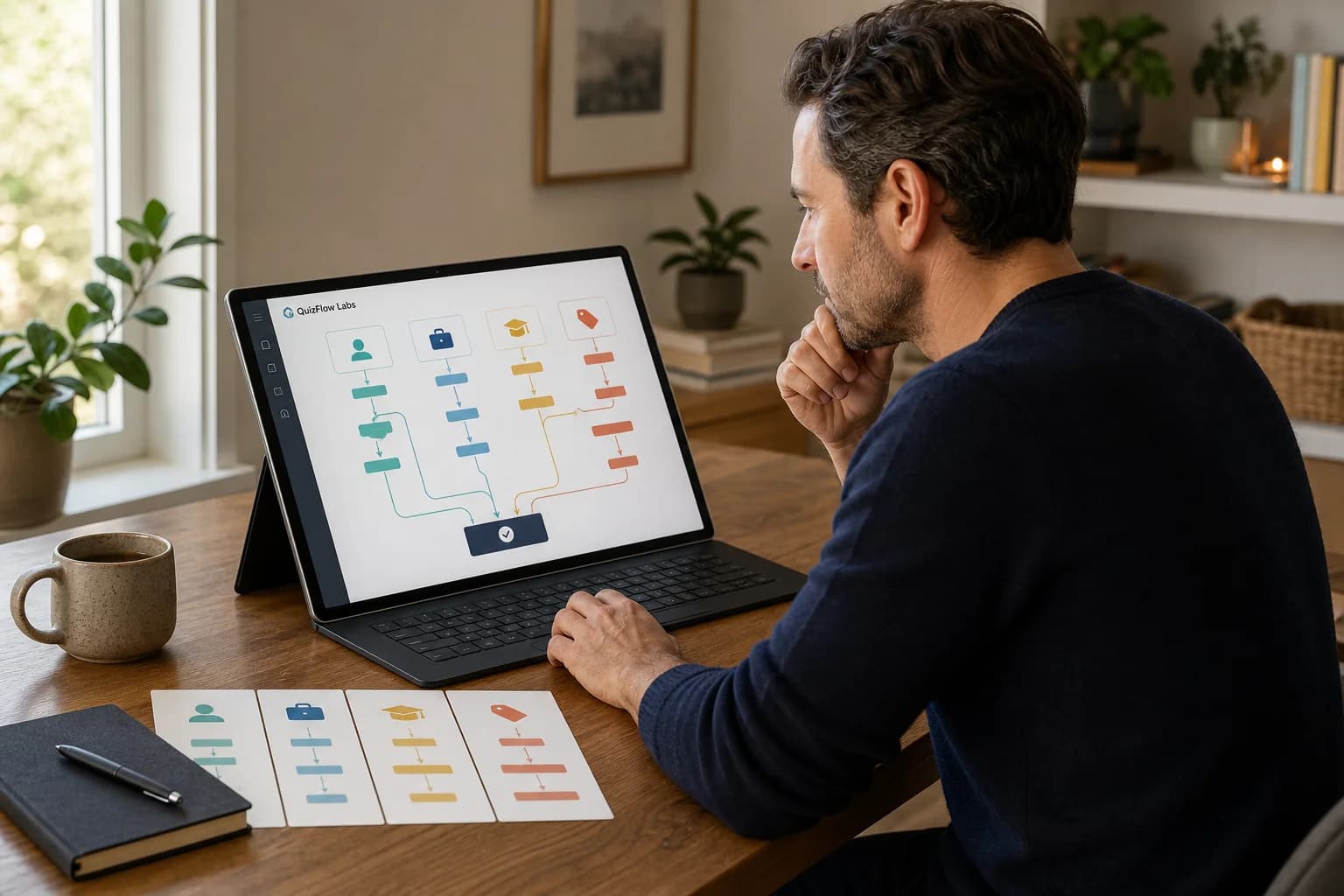
In QuizFlow Labs, these goals can be represented as Intent Paths: named entry routes within one flow. Each intent can have its own starting step, assigned blocks, end route, visual context, direct URL, and completion outcome while still sharing the same builder, submissions, and analytics.
Intent Paths give the experience a structure that people can name and understand.
Instead of looking at a canvas filled with rules and asking, 'Where does this arrow go?' you can ask, 'What should happen when someone enters the Product Finder path?' That is a much more durable design question.
Find the right product
Guide someone from a goal and constraints toward an appropriate recommendation.
Book a consultation
Begin near qualification and readiness, then finish with scheduling.
Request support
Start with issue type and urgency, then route toward the right help.
Get pricing
Focus the journey on fit, budget, and the most relevant pricing action.
An intent is not a branch for every variation
Intent-first design does not mean turning every answer into a new intent. An intent should represent a meaningful visitor goal—not every audience characteristic, preference, or product attribute.
Book a consultation is an intent. Prefers morning appointments is a detail that can be collected within the booking journey.
Find the right product is an intent. Values simplicity may be a tag, scoring input, or preference used to refine the recommendation.
Request support is an intent. Uses an Android device may trigger a relevant troubleshooting question within the support path, but it is not necessarily a separate intent.
A useful test is to ask: Would this difference change the promise made at the beginning of the journey?
If two people are trying to accomplish the same thing and should begin in the same place, they probably belong to the same intent. Use branching, tags, variables, scoring, or conditional outcomes to handle the smaller differences discovered along the way.
Use branching only when the next step should change
Once the visitor is inside the appropriate Intent Path, branching logic can make that journey more attentive.
A branch is justified when an answer meaningfully changes what the participant needs next. Most useful branches perform one of four jobs.
Skip
Remove questions that no longer apply so the participant avoids unnecessary work.
Investigate
Ask a focused follow-up because an answer created a genuine need for more context.
Route
Send the participant toward a different kind of help, offer, Intent Path, or experience.
Conclude
End the journey when the appropriate next step is already clear.
Skipping is often the quietest and most valuable form of personalization. The participant does not see the logic. They simply avoid irrelevant questions.
Good branching also knows when to stop asking. If an answer confirms that someone is ready to book, ineligible for an offer, facing an urgent issue, or better served by another resource, continuing may add friction without improving the outcome.
Branch early on intent and later on detail
The beginning of a flow should establish direction without demanding too much information.
If the visitor has not already entered through an intent-specific button or link, an early Path Chooser can ask a simple question such as: What would you like help with today?
The answer can route the participant into a named path such as Product Finder, Get Pricing, Book a Demo, or Support. That first decision is broad because it establishes the journey.
Questions within the intent can then become progressively more specific. A Product Finder path might ask about the customer's goal, context, constraints, and preferences. A Support path might ask about the affected product, issue type, urgency, and previous troubleshooting.
This creates a natural hierarchy: Why are you here? What do we need to understand within that goal? Which next step fits what we learned?
Without that hierarchy, creators often use a sequence of small branches to approximate a journey that should have been named from the start.
Let different paths share what they genuinely have in common
Intent Paths do not require duplicating every block.
Several journeys may need the same privacy explanation, consent choice, contact information, lead-capture step, booking component, or completion instructions.
Those paths can diverge where the questions differ and converge again where a shared step honestly serves everyone.
A Product Finder can ask about goals and preferences. Compare Services can ask about needs and constraints. Book a Consultation can ask about timing and readiness. All three can then meet at a shared contact step before receiving intent-specific completion messages and CTAs.
This is easier to maintain than creating three copies of the same contact and consent language. If the shared copy changes, it changes once.
Personalization does not mean every person must receive a completely unique sequence. It means differences are respected where they matter.
Give each routing tool one clear job
Complexity grows when several tools are used interchangeably. Each one should have a clear job.
Intent Paths organize goals. Branching logic controls movement. Tags describe what you learned. Scores compare accumulated evidence. Variables preserve facts and state. Conditional outcomes personalize completion.
Consider a software recommendation flow: the intent is Find the right plan; a branch separates individual and team use; a variable stores team size; a tag records the need for advanced reporting; scoring compares the Professional and Business plans; and the outcome presents the recommendation with the relevant explanation and CTA.
Using the tools this way keeps the logic explainable. Intent does not have to carry every preference, and branching does not have to become the database of everything learned.
Do not branch when the answer changes nothing meaningful
Branching can create the appearance of sophistication without creating value.
Before adding a rule, complete this sentence: Because the participant answered differently, they now need _____ instead.
If the answer is merely slightly different wording, a tag or personalized explanation may be enough. If everyone still needs the same next question, there may be no reason to branch. If the difference matters only at completion, save it and use a conditional outcome.
Avoid branches that lead to nearly identical copies of the same steps, produce the same result for no clear reason, exist only to demonstrate personalization, or create maintenance work without reducing participant effort.
The goal is not to maximize the number of possible paths. It is to create the smallest number of paths required to respond appropriately.
Map the journey before configuring rules
Do not discover the architecture while adding conditional rules inside the builder. Begin with a simple map.
For each Intent Path, record the visitor goal, starting step, unique questions, shared blocks, decisions that justify a branch, possible early exits, natural end route, and completion CTA.
Then identify merge points. Ask where two or more intents can safely rejoin a common sequence. Finally, add the local branching rules within each path.
This order prevents the flow from becoming a collection of arrows without an organizing idea. It also makes reviews easier: a colleague can evaluate whether the Product Finder journey makes sense without first understanding every individual condition in the system.
Test paths, not just individual rules
A branching rule can work correctly while the complete journey still feels wrong. Testing should therefore happen at two levels.
First verify the mechanics: each intent begins at the correct step, conditions route correctly, skipped questions are excluded, merge points preserve collected information, and every path has a valid ending without loops or unreachable blocks.
Then test as a participant. Does the first question match the reason you entered? Does each follow-up make sense after the previous answer? Are you asked anything irrelevant? Does the ending reflect both your intent and what you revealed? Is the next action clear?
Test obvious routes, edge cases, changed answers, direct intent URLs, Bio Funnel buttons, hosted pages, and embedded versions you plan to publish.
The objective is not merely to prove that the rules execute. It is to confirm that every route feels like one coherent conversation.
The best branching logic feels invisible
Participants should not need to admire the complexity of a decision flow.
They should notice that the questions are relevant. They should avoid sections that do not apply. They should receive useful follow-ups when their situation requires them. They should reach an ending that reflects why they came and what they said.
That experience does not require endless branches. It requires a clear hierarchy: entry goal, Intent Path, focused branching, shared steps, and an appropriate outcome.
Intent gives the journey meaning. Branching gives it responsiveness. Shared blocks keep it maintainable. Conditional outcomes turn what was learned into a useful next action.
The measure of good branching is not how many paths you created. It is how naturally each person reaches the path that makes sense.
Build paths around what visitors want
Create a decision flow that stays personal without becoming complicated.
QuizFlow Labs helps you organize visitor goals with Intent Paths, adapt each journey with focused branching, reuse shared steps, and finish with the right outcome.
Explore Intent PathsFAQ
What is branching logic in a quiz?
Branching logic changes what happens next based on an answer or saved value. It can skip questions, add follow-ups, route someone to another step or Intent Path, open a different destination, or finish the flow.
What is the difference between an Intent Path and branching logic?
An Intent Path represents the visitor's meaningful entry goal and organizes the overall journey. Branching logic makes focused routing decisions within or between those journeys as new information is collected.
When should I create a separate Intent Path?
Create one when a visitor goal changes the promise, starting point, major questions, end route, or completion action. Use tags, variables, scoring, or local branching for smaller differences within the same goal.
Can different Intent Paths share quiz steps?
Yes. Multiple paths can share explanations, consent, lead capture, contact questions, booking, or closing steps. Sharing common blocks reduces duplication and keeps the flow easier to maintain.
How do I keep branching logic manageable?
Map visitor intents first, give every tool one clear job, branch only when the next step genuinely changes, reuse shared steps, define every ending, and test complete participant paths rather than isolated rules.