

How to Design a Product Recommendation Quiz That Feels Like Expert Advice
A useful recommendation quiz does more than collect preferences. It asks the few questions an expert would need, explains the recommendation, and gives the customer a confident next step.
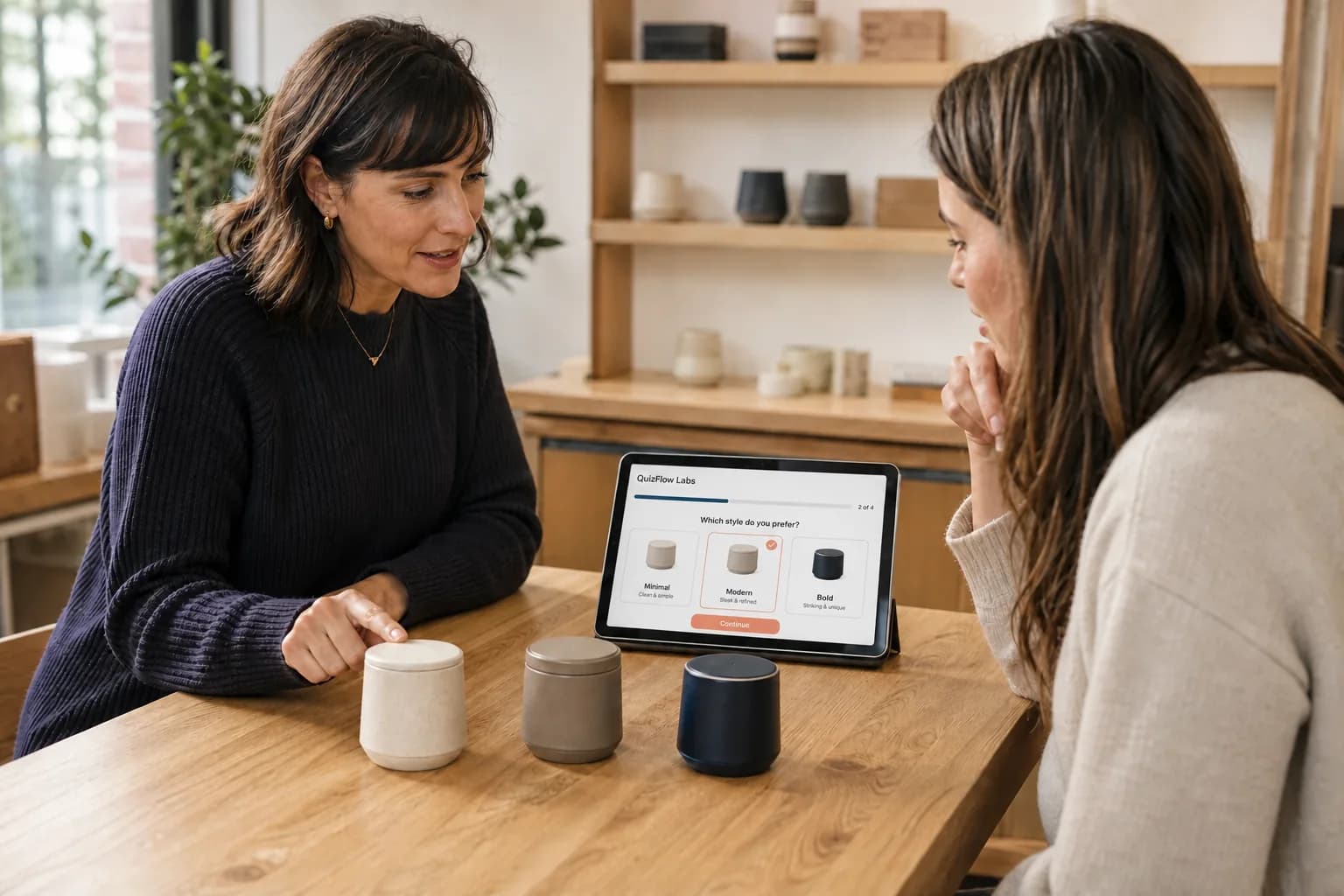
A recommendation is a promise
Imagine walking into a specialty shop and asking for help choosing between several products.
A knowledgeable advisor would not begin by reading every product description aloud. They would ask a few questions. What are you trying to accomplish? What have you already tried? Which constraints matter? What would make one option better for your situation than another?
Then they would use the answers.
They might eliminate products that are unsuitable, compare the remaining options, explain the tradeoffs, and recommend a sensible next step.
A product recommendation quiz makes a similar promise. It tells the customer: answer these questions, and we will help you choose.
That promise raises the standard for the experience. If the questions feel generic, the recommendation seems predetermined, or every path leads to the same bestseller, the quiz has not provided guidance. It has placed extra steps in front of a product page.
The best product recommendation quizzes do something more valuable. They recreate the judgment of a thoughtful advisor in a structured, repeatable experience. They do not merely ask what someone likes. They learn enough to reduce uncertainty.
Begin with the decision, not the questions
The easiest way to build a weak recommendation quiz is to begin by writing questions.
Questions feel like the visible substance of a quiz, so creators often open a blank builder and ask, 'What could we ask our customers?' That produces long lists of potentially interesting questions. It does not necessarily produce a useful recommendation.
Begin with the decision instead.
List the products, services, packages, or collections the experience may recommend. Then identify the differences that should actually affect the choice.
This creates a recommendation model before it creates a questionnaire.
For example, a skincare brand might recommend products based on skin concerns, sensitivity, routine complexity, and preferred texture. A software company might distinguish plans by team size, required workflow, collaboration needs, and expected volume. A consultant might route prospective clients based on the problem, stage, urgency, budget, and level of support required.
The format changes, but the design principle does not: define what makes each outcome appropriate before asking people to supply the evidence.
Define the fit
Clarify who each possible recommendation serves particularly well.
Identify the constraints
Document when an otherwise appealing option should not be recommended.
Understand the tradeoffs
Name the meaningful differences that separate one suitable option from another.
Ask the questions an expert would ask
Once the outcomes are clear, questions become easier to judge.
A question belongs in the quiz when its answer can improve the recommendation, route, explanation, or next action. It does not belong merely because the answer would be interesting to know.
Strong recommendation questions usually explore five areas: the goal, the context, the constraints, the priorities, and the customer's readiness.
The goal reveals what the person is trying to accomplish. Two customers can look similar demographically and still need different products because their desired outcomes differ.
The context explains where, when, and how the product will be used. A recommendation that works well for daily professional use may be excessive for occasional personal use.
Constraints identify what would make an otherwise appealing product unsuitable. Budget, compatibility, allergies, timing, location, available space, and technical requirements can all prevent a poor match.
Priorities help rank several options that could all work. One customer may value simplicity, while another accepts more complexity for greater control.
Readiness determines the right immediate action. A ready buyer may want to purchase. An uncertain buyer may need a comparison. A person with an unusual situation may need advice before committing.
Separate filters from preferences
Not every answer should influence a recommendation in the same way.
Some answers are filters. They determine whether an option is possible. If a product is incompatible with the customer's equipment, outside the available budget, unavailable in their region, or unsuitable for a stated need, it should normally be removed from consideration.
Other answers are preferences. They help rank several options that could all work. A customer may prefer a lighter product, simpler setup, particular style, or added feature without making the alternatives wrong.
This distinction matters because recommendation quizzes frequently rely on scoring alone. Each answer adds points to different outcomes, and the highest score wins.
Scoring is useful when preferences accumulate. It is less reliable when a single answer creates a hard constraint.
A better model uses filters or branching to remove unsuitable paths, tags or scores to compare the options that remain, and the completion experience to explain why the final match fits.
This is closer to how an expert makes a recommendation. They do not allow five minor preferences to outweigh one decisive incompatibility.
Ask about the customer's world, not your product catalogue
Businesses naturally think in product specifications, internal categories, and feature names. Customers usually think in situations, concerns, and desired outcomes.
A weak question asks customers to perform the matching themselves: 'Which product family do you prefer?' A stronger question gives the business information it can use: 'What are you hoping to improve first?'
Asking someone to choose between technical terms they do not understand transfers the difficult part of the decision back to them.
If a customer already knew which material, configuration, method, plan, or product family was correct, they might not need a recommendation quiz.
Use the language customers use when speaking to a helpful employee. Ask about their experience, environment, priorities, frustrations, and intended use. Let the recommendation logic translate those answers into product criteria behind the scenes.
Some decisions require technical information. When they do, explain the term, show an example, or provide an 'I'm not sure' option that keeps the person moving without forcing a guess.
Good guidance reduces the amount of expertise the customer must bring to the interaction.
Make every answer affect something
People notice when their answers do not matter.
If someone identifies a specific concern and receives the same questions, content, and recommendation as everyone else, the personalization begins to feel theatrical.
An answer does not always need to change the final product. It should, however, improve some part of the experience.
It might skip an irrelevant question, introduce a necessary follow-up, eliminate an unsuitable option, add weight to a likely match, change an explanation, select a relevant resource, personalize the reason behind the recommendation, or change the next action.
This is why a shorter, well-designed quiz can outperform a longer questionnaire. The value comes from how the answers are used, not how many data points are collected.
Before keeping a question, complete this sentence: If the customer chooses a different answer, the experience will change by _____. If there is no meaningful answer, remove the question or redesign how its response is used.
Explain why the recommendation fits
A product name and a purchase button are not a complete recommendation.
A knowledgeable advisor would explain their reasoning: 'Based on what you told me about your priorities and how you plan to use it, this is the option I would start with.' The completion screen should do the same.
A credible result names the recommendation, explains why it fits the person's situation, acknowledges a relevant tradeoff, and makes the next step clear.
The explanation does not need to expose every scoring rule. It should connect the customer's most important answers to the qualities that make the recommendation appropriate.
For example: 'You told us that ease of setup matters more than advanced customization and that you expect to use the product occasionally. The Starter option gives you the essential workflow without the added complexity of features you are unlikely to need yet.'
That feels more trustworthy than 'Your perfect match is Starter!' because it shows that the recommendation came from the person's answers.
The result can also acknowledge a tradeoff: 'If detailed team permissions become important later, the Professional option may be a better long-term fit.' Honest guidance builds confidence. It does not need to pretend one product is perfect in every respect.
Recommend confidently without pretending certainty
Real customer decisions are not always clean.
Two products may be similarly suitable. The customer may give conflicting answers. Important information may be missing. Occasionally, nothing in the catalogue is an honest fit.
A recommendation system should be designed for these cases rather than forcing every person into a confident result.
When two options are close, offer a comparison and explain the deciding difference. When information is incomplete, ask one clarifying question or describe the assumption behind the recommendation. When a situation is too complex for an automated choice, route the person to a human conversation.
And when no option is suitable, say so respectfully.
That may feel like a lost conversion, but an unsuitable sale can create returns, support costs, disappointment, and lost trust. A useful recommendation flow protects the customer from a poor choice as well as helping them make a good one.
The goal is not to manufacture certainty. It is to reduce uncertainty honestly.
Design the next step as carefully as the recommendation
The completion moment is where guidance becomes action.
After receiving a recommendation, the customer should not have to return to the beginning of the website and figure out what to do with it.
The right action might be to view the recommended product, compare two strong matches, shop a recommended routine, choose a package, start a trial, book a consultation, save the recommendation, or ask a specialist a question.
Choose one primary action that advances the decision. Supporting actions can remain available, but they should not compete equally for attention.
The CTA should preserve context. 'View your recommendation' is more meaningful than 'Learn more.' 'Compare your two matches' is more useful than sending the customer to an unfiltered catalogue.
A recommendation is valuable because it narrows the path. The completion experience should not immediately widen it again.
Test recommendation quality, not only completion rate
Completion rate can reveal friction, but it cannot tell you whether the recommendation was good.
A short quiz that produces weak matches may be easy to finish and still fail its purpose. A slightly longer flow may create more confidence if every question improves the outcome.
Evaluate whether customers understand the questions, whether particular questions cause avoidable exits, whether the recommendation makes sense when reviewed manually, and whether people act on the result.
Before launch, test the flow with realistic customer profiles. Include obvious matches, close calls, conflicting preferences, hard constraints, and no-fit situations.
For each profile, ask not merely, 'Did the logic produce the expected product?' Ask, 'Would a knowledgeable advisor be comfortable giving this recommendation and explanation?'
That is the more meaningful quality standard.
The best product quiz feels less like a quiz
Customers do not begin a product recommendation quiz because they want to answer questions. They begin because choosing is difficult.
The questions are the cost of receiving guidance.
Every part of the experience should therefore earn the customer's effort. Ask only what improves the decision. Use familiar language. Remove impossible options before ranking preferences. Explain the recommendation. Be honest about uncertainty. End with a next step that preserves the clarity the quiz created.
When those elements work together, the experience stops feeling like a marketing questionnaire. It feels like useful advice.
That is the opportunity behind a well-designed product recommendation quiz: not simply to personalize a product page, but to give every customer access to the kind of thoughtful guidance that usually requires a knowledgeable person standing beside them.
Turn product choices into confident next steps
Build a recommendation flow that uses every answer with purpose.
QuizFlow Labs helps you combine branching, tags, scoring, product guidance, and personalized completion actions to recommend the right option and make the next step clear.
Explore decision-flow featuresFAQ
What is a product recommendation quiz?
A product recommendation quiz asks customers a focused set of questions and uses their responses to recommend the most suitable product, service, package, or collection for their needs.
What questions should a product recommendation quiz ask?
Ask about the customer's goal, usage context, hard constraints, priorities, and readiness. Keep a question only when its answer can improve the recommendation, route, explanation, or next action.
Should a recommendation quiz use branching or scoring?
Use branching or filters for decisive constraints that make an option unsuitable. Use tags or scoring to rank several suitable options based on accumulated preferences. Many strong recommendation flows combine both approaches.
How should a product quiz explain its recommendation?
Connect the customer's most important answers to the qualities that make the product appropriate, acknowledge a meaningful tradeoff when relevant, and provide one clear next action.
What if no product is a good match?
Do not force a misleading recommendation. Explain the limitation honestly and offer a helpful alternative, such as a comparison, educational resource, waitlist, or conversation with a knowledgeable person.