
01
Ask with purpose
Begin with the decision, insight, or outcome the questions should support.
Interactive survey alternative
Build adaptive decision flows that listen, segment, personalize, and guide each respondent toward a useful next step.
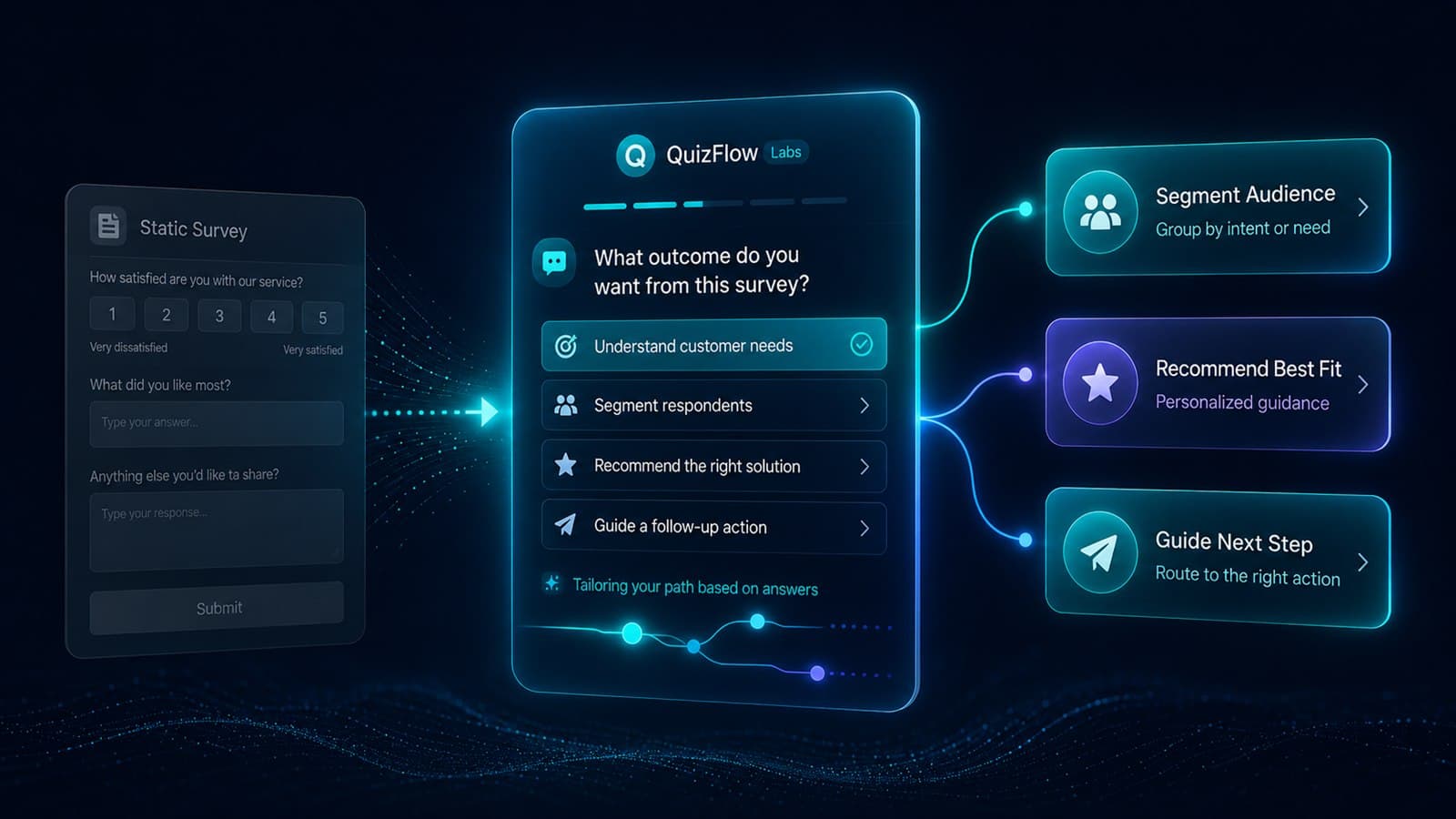
Ask less, learn more
Remove irrelevant questions with branching.
Interpret as you collect
Turn responses into segments and signals.
Act at completion
Return a result while intent is active.
From response to result
A decision flow keeps the value of structured questions and adds relevance, interpretation, and action.
Begin with the decision, insight, or outcome the questions should support.
Use branching to ask relevant follow-ups and remove questions that no longer matter.
Turn structured responses, tags, and scores into useful segments and context.
Recommend, route, personalize, or guide the respondent while their intent is active.
Choose the right tool
The difference is not the question format. It is what the experience should do with the answer.
| Category | Traditional survey | Interactive decision flow |
|---|---|---|
| Primary job | Collect answers for later review | Guide each person toward an outcome |
| Question path | Mostly fixed and linear | Can adapt based on responses |
| Completion | Often a generic thank-you | Result, recommendation, route, or CTA |
| Business output | Response records and reports | Segments, context, and next-step actions |
| Best fit | Broad research and standardized feedback | Qualification, personalization, and action |
Traditional surveys remain a strong choice for standardized research and broad opinion collection.
Built for actionable insight
Use adaptive feedback when responses should change a journey, not simply enter a report.
Turn broad questionnaires into guided paths that understand needs and route action.
Transform assessments and audience surveys into personalized learning or content paths.
Segment prospects, support needs, onboarding signals, and product-fit feedback.
Use interactive research when the campaign goal includes conversion or routing.
Product proof
Personalize the question path and remove irrelevant prompts.
Learn moreTurn answers into segments and useful follow-up context.
Learn moreReturn a recommendation, result, CTA, or appropriate next path.
Learn moreUnderstand completion, drop-off, leads, and outcome performance.
Learn moreUse answers to identify fit and route the next conversation.
Respond differently to positive, neutral, and dissatisfied customers.
Match respondents with a service, plan, product, or resource.
Turn needs and preferences into useful audience groups.
Adapt guidance based on goals, experience, or readiness.
Collect insight while returning a personalized result or action.
Start with a proven structure
Preview a relevant starting point, then customize the questions, logic, branding, capture moment, and outcome for your audience.
Before you switch
A survey alternative still asks questions, but it uses answers to adapt the experience, create segments, recommend an option, route the respondent, or return another useful next step.
Use a decision flow when answers should immediately influence follow-up questions or trigger qualification, personalization, routing, booking, or a tailored recommendation.
QuizFlow Labs is a stronger fit when you need branching, personalized outcomes, lead capture, recommendations, and routing. Traditional survey tools may remain better for broad research programs and standardized long-form opinion collection.
Yes. You can collect feedback while using responses to personalize follow-up questions, assign segments, show different messages, or guide people toward different actions.
Branching removes irrelevant questions, while outcome-focused completion gives respondents a result or action instead of ending the experience with no guidance.
Build an interactive decision flow that listens, adapts, and gives every respondent a more useful next step.