

How to Ask About Project Budget in a Client Intake Form
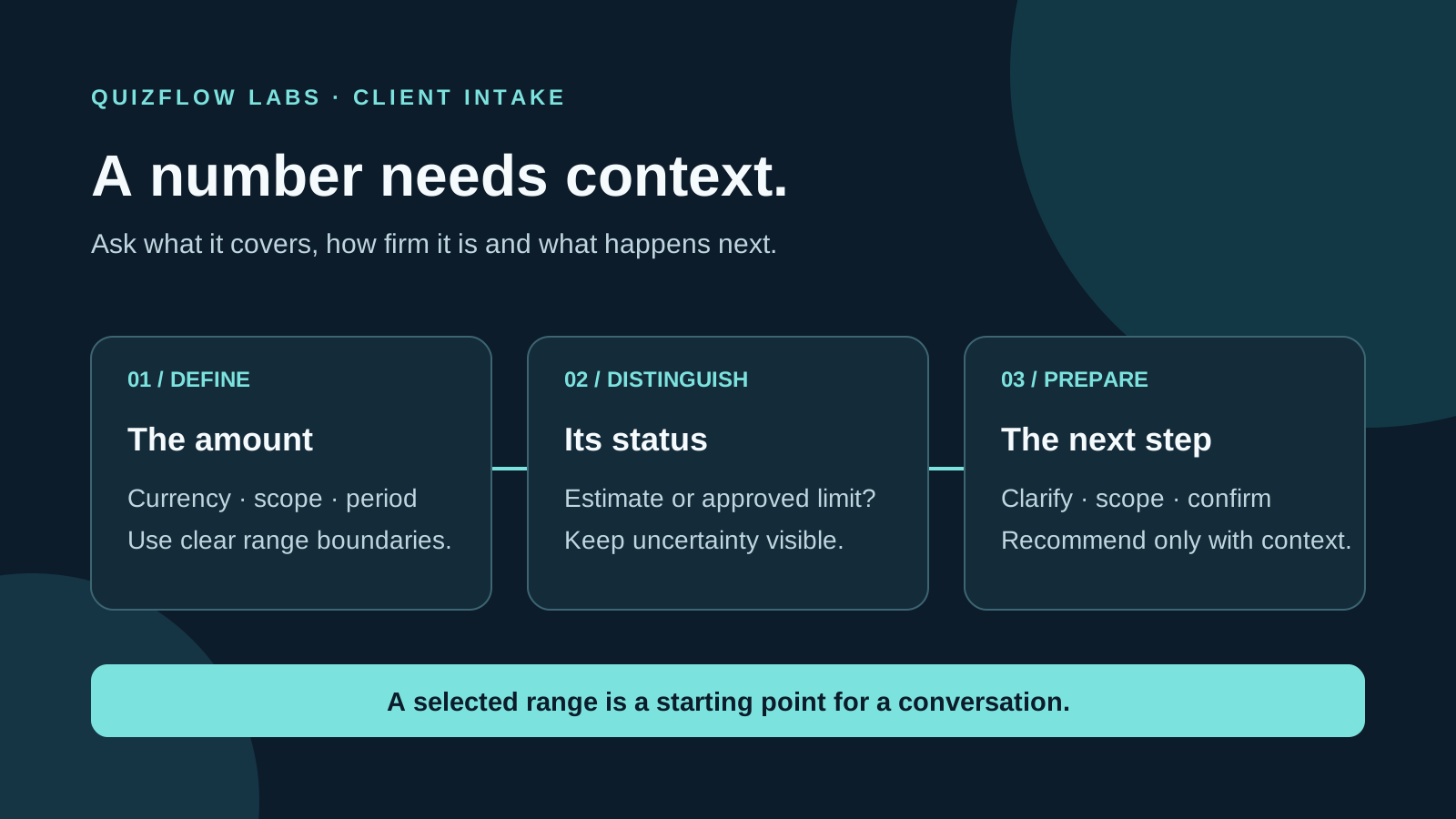
A useful budget answer tells you what kind of conversation to have next. Define the cost, ask for the precision you need and keep an estimate separate from permission to spend.
Make the budget question serve a specific decision
A project budget question can help a service business assess scope, suggest a suitable starting point or prepare a useful consultation. But “What is your budget?” leaves several things unresolved. The number might describe a preferred price, a rough estimate, an approved limit or the entire project cost, including work your business does not provide.
Start with the decision the answer will change. If you need to distinguish a small advisory engagement from a full implementation, a broad range may be enough. If every inquiry receives the same initial scope review, collecting an exact amount may add little. If the service has one fixed price, showing that price and asking whether the person wants to discuss that service can be clearer than asking them to invent a budget.
Write the intended use in plain language before the question: “This helps us suggest a realistic scope for the first conversation.” Use that explanation only if it describes what your team actually does. An answer collected for scoping should not silently become proof that a prospect has approved a purchase.
Define what the money covers before asking how much
Name the currency, the time basis and the included costs. A dollar sign alone leaves the currency unclear for an international audience. A monthly service fee and a one-time project fee are different quantities. So are a supplier fee and a total launch budget that must also cover advertising, software and other suppliers.
Keep the question aligned with the service being considered. “What amount are you planning for the one-time website design work, in CAD, before tax?” is more interpretable than “Marketing budget?” Explain important exclusions nearby, such as hosting and paid advertising, if those are outside the fee. Use the same basis when showing your own estimated prices.
Provide enough scope and price context for a meaningful answer. Someone who does not yet know whether the work requires a consultation or a six-month implementation may need guidance before they can estimate a cost. Showing a genuine starting price or explaining the factors that change the fee can make the next question answerable. Never present an artificially low starting price that does not describe an available service.
The UK Parliament Design System advises explaining why sensitive information is needed and what will happen to it. Apply that principle here with a short, truthful reason for asking. Avoid requesting financial documents, account details or unrelated revenue figures when a project range is sufficient.
Read Parliament’s guidance on asking sensitive questionsOpens in a new tabChoose ranges around the decisions you can actually make
Use a range when nearby amounts lead to the same next step. Design its boundaries around meaningful changes in service scope, rather than attractive round numbers alone. If every answer from CAD 3,000 to CAD 8,000 requires a scope conversation, several small bands inside that interval may create distinctions your team cannot use.
Make the bands cover the intended amounts without overlaps or gaps. “Under CAD 3,000,” “CAD 3,000 to under CAD 8,000,” and “CAD 8,000 or more” give an amount of exactly CAD 3,000 one home. “CAD 1,000–3,000” followed by “CAD 3,000–8,000” does not. Explicit boundaries also work when the amount includes cents.
The Australian Bureau of Statistics recommends mutually exclusive, comprehensive response categories and appropriate non-numeric answers such as not knowing or preferring not to answer. Choose the actual boundaries from viable service scopes and changes in what you can offer.
The tradeoff is lost precision. A person selecting CAD 3,000 to under CAD 8,000 has not said they can spend CAD 8,000. Do not assume the top of the band is available when preparing a proposal, or use its midpoint as a confirmed amount. If a precise limit matters before proposing work, confirm it in the scoping conversation. Ask for an exact figure in the form only when that precision changes the immediate decision and the person can reasonably supply it.
See the ABS guidance on closed-question response categoriesOpens in a new tabSeparate an unknown amount from an unapproved amount
“I need help estimating” means the person cannot yet give a useful amount. “Approval is still pending” means an amount may exist but is not committed. “I prefer to discuss this” withholds the number without explaining why. None of these establishes a zero budget or poor fit.
Avoid mixing these meanings into a single “Not sure” option if the distinction changes your response. Equally, avoid forcing them into one list alongside amounts when someone could truthfully choose both a range and “approval pending.” A single-choice answer should not make the person discard an important fact.
One practical design is to ask for the planned range, with separate alternatives for needing help estimating and preferring to discuss it. Then, only if readiness changes the next step, ask a second question about the status of the stated amount: a working estimate not yet submitted for approval, an amount submitted and awaiting approval, or an approved amount for this work. Do not add this second question if nobody will use the distinction.
Keep budget status separate from the respondent’s authority. An approved project budget does not necessarily mean the person completing the form can sign a contract. If you need to know who participates in the decision, ask about that process respectfully. Do not infer it from a job title or a high amount.
Example: scoping a small business website project
Consider a hypothetical website studio offering a limited advisory session and custom design projects. Its custom projects start at CAD 3,000 before tax; the actual price depends on scope. It needs to decide whether the first conversation should explore a custom project, explain a smaller service or help the prospect estimate the work.
After asking what the website needs to accomplish, the studio explains that custom design starts at CAD 3,000, with hosting and advertising excluded. It asks: “What amount are you planning for the one-time website design work, in CAD, before tax?” The answer list is under CAD 3,000; CAD 3,000 to under CAD 8,000; CAD 8,000 or more; I need help estimating; and I prefer to discuss the amount.
For someone who chooses a range, the team also needs to know whether it is a working estimate not yet submitted for approval, an amount submitted and awaiting approval, or an approved amount for the work. An optional prompt can collect a relevant constraint: “Is there anything about the scope or funding process we should understand before we talk?” The studio does not ask for bank statements or evidence of funds.
A CAD 3,000-to-under-CAD 8,000 early estimate supports a scope conversation, not a confirmed custom-project fit. The project could require more work than that range covers. A lower range can prompt an explanation of the advisory session if that service addresses the goal; it should not trigger an irrelevant cheaper offer. Needing help estimating calls for clarifying deliverables and cost drivers.
The final message should reflect the next actual step. “Discuss the project scope” is appropriate if a conversation still needs to happen. “Your project is accepted” is not justified by a selected budget range. A useful flow preserves uncertainty until someone has enough information to resolve it.
Diagnose weak answers before tightening qualification
If many people need help estimating, check whether the service description makes the work understandable. Ask a few intended users what they included in their estimate and what price information they were missing. A high unknown count is a reason to investigate the question and offer context; it does not establish that the audience cannot afford the service.
If answers cluster just above a displayed minimum, find out whether people mean an approved limit, a tentative starting point or simply the first plausible option. The pattern alone cannot identify the cause. Do not interpret it as willingness to pay more, and do not change the labels merely to produce higher numbers.
If later conversations repeatedly reveal costs outside the stated range, compare the original answer with its scope and tax basis. The customer may have included advertising while your team assumed design fees only. If the definitions agree, investigate changing requirements or approval constraints. These require different fixes from rewriting a confusing question.
Review the downstream usefulness of the answer as well as form completion. Can the team prepare a more relevant conversation? How often does it need to ask the budget question again because the original meaning was unclear? Keep the wording, price context and range definitions with those observations. Moving a boundary or displaying a new starting price changes the answers’ context, so a higher-range share alone does not prove lead quality improved.
Set up a clear budget question in QuizFlow Labs
Use a Multiple Choice block in QuizFlow Labs with Selection mode set to Single select for a planned budget range. Put the currency, fee period and scope in the question and supporting explanation. Include truthful alternatives for people who need help estimating or want to discuss the amount. Choose labels that each represent one answer to that question.
Use a separate question for budget status when it affects the conversation. For written context, add a Text Response and leave Required response off if the explanation is optional. Keep free text for context your team will read, rather than treating a phrase such as “around five thousand, approval pending” as an automatically verified spending limit.
Before sharing the intake flow, test an amount exactly at each boundary, an unknown amount and a known amount awaiting approval. Ask someone to explain what costs they included. Read the final message and follow-up action for each case. The question is useful when the answer helps you choose an honest next step and your team understands what still needs to be confirmed.
Configure a Multiple Choice blockTurn answers into action
Build intake that prepares a better first conversation
Use QuizFlow Labs to collect the scope, budget context and next-step information your service team can act on.
Start building with QuizFlow Labs