

How to Estimate Completion Time for a Branching Quiz
Measure realistic journeys, separate answering from follow-through, and decide whether a time estimate will help visitors prepare.
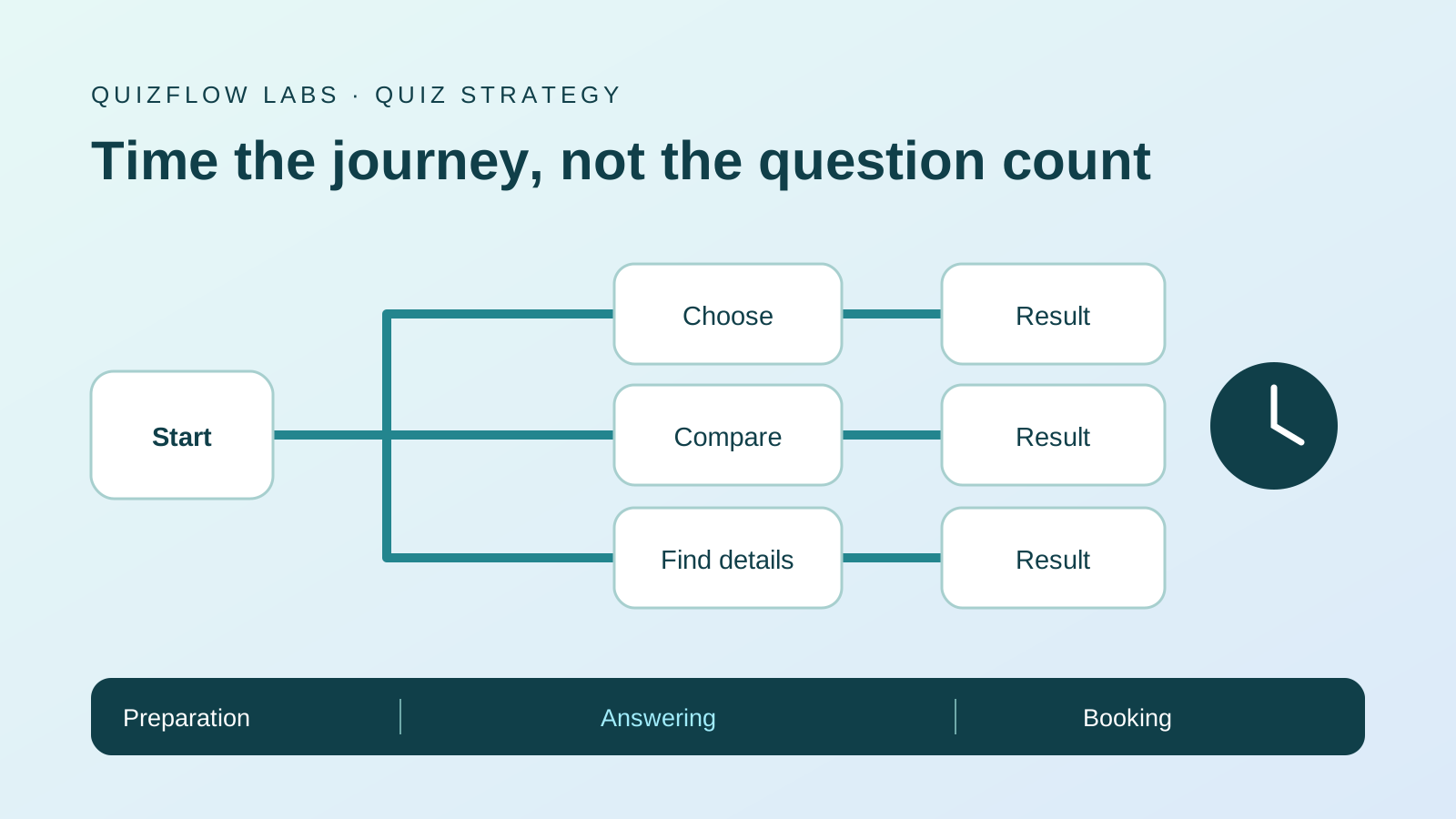
A useful estimate describes the work visitors will actually do
A completion-time estimate helps someone decide whether to start a quiz now. For a branching quiz, that estimate needs to account for different journeys: one visitor may make a few familiar choices, while another needs to read an explanation, compare options or find information before answering.
Counting questions is a starting point for mapping the flow, but it does not measure effort. A short question about a project deadline can take longer than several preference questions if the answer depends on a colleague. The useful question is: how long does this task take people who have not already learned the quiz?
Measure realistic paths before choosing a number. If the work varies too much to summarize honestly, explain what visitors will need instead. Preparation guidance can be more helpful than a precise-looking estimate.
Define where the clock starts and stops
Write down the promise you want to make before timing anything. An estimate for ‘get your recommendation’ should include reading the quiz introduction, answering, correcting mistakes and reaching the result. It should not quietly stop at the last answer if visitors still have to complete a required contact step to see that result.
Keep later work separate. Reading a long recommendation, choosing an appointment and completing a booking are different tasks. If your estimate ends when the recommendation appears, say so. A fast quiz does not establish that the whole booking journey will be fast.
Choose observable boundaries, such as ‘from the introduction becoming visible to the recommendation appearing.’ Use the same boundaries in every timing session. Note loading waits within those boundaries, too: visitors experience them even when the cause is outside the question wording.
Sample paths by effort, not just by screen count
Map the main routes and identify what could change the work: reading, typing, looking something up, correcting an answer or comparing unfamiliar choices. Include common routes and any route that introduces a substantial extra task. A less common path still matters if it makes the shared introduction’s promise misleading.
Ask people who resemble the intended audience to attempt a relevant task on the kind of device they would normally use. Use a test version without live bookings, payments or follow-up messages, and provide safe sample information where needed. Check that the sample information does not make the task artificially easy. Supplying a ready-made answer removes the work of finding it.
Keep a simple session record: route taken, device and access method, elapsed time, whether the task was completed, whether help was given, and the point of any delay. GOV.UK’s usability benchmarking guidance treats time, successful completion and abandonment as separate measures. A few walkthroughs are useful for finding problems; they do not establish a reliable population-wide completion-time claim.
Example: a workshop finder with two kinds of effort
Consider this hypothetical workshop finder. An individual chooses a topic and experience level, then sees a recommendation. A team organizer also needs to answer a question about the number of attendees. Both routes lead to a workshop recommendation; reserving seats happens afterward.
Timing only the individual route would miss the organizer’s work. Giving every test participant a group size in advance would also miss it. Test the organizer route with people who can judge whether they would know that number, and ask afterward how they would obtain it if they did not.
If organizers repeatedly pause to confirm attendance, decide whether an approximate group size is enough for a useful recommendation. If exact numbers are needed only to reserve seats, move that request to the reservation process. If an exact number genuinely changes which workshop can accommodate the group, keep the question and explain before starting that organizers will need it.
The estimate can then describe the recommendation task, with seat reservation clearly separate. No faster wording can remove a real dependency on another person’s answer. Resolve the dependency or help visitors prepare for it.
Keep slow, assisted and unfinished attempts visible
Do not discard a slow attempt just because it makes the estimate less attractive. First find out what happened. Repeated rereading at one choice may indicate unclear wording; repeated lookup pauses may reveal a preparation requirement. Deliberate comparison of suitable options may be useful decision-making rather than a defect.
Record unrelated interruptions separately from work caused by the task. If someone answers a phone call, preserve the full elapsed time and note the interruption rather than silently changing the record. If someone leaves to find a required document, that pause is evidence about the task itself.
Keep assisted completions separate from unaided ones. A session where you explain a confusing question does not show how quickly a visitor can finish alone. Discussion and thinking aloud can also change the timing conditions. Use those sessions to diagnose the flow, then check the revised task in a separate timing round without coaching or ongoing commentary.
An unfinished attempt has no completion time. Record where it ended and why, when known. Reporting only the times of successful finishers can conceal a route that people cannot complete. Review the number of attempts and completions alongside any time summary.
Choose wording the evidence can support
Compare times within each route before combining them. A median is the middle time after sorting completed times, or the average of the two middle times for an even number of completions, but it does not describe the slowest route or the experience of people who stopped. Pooling routes also gives more influence to whichever route had more completed test sessions, which may not match your visitor mix.
If completed times cluster across relevant routes and the test conditions reflect real use, a rounded approximate duration may be useful. If routes form clearly different groups, consider a route-specific estimate after visitors choose their task. A broad range is another option, but it still needs evidence: the fastest and slowest observations in a small test are not dependable bounds for everyone.
‘Most people finish in…’ makes a claim about a proportion of people. Do not derive it from your own fast walkthrough or a handful of convenient testers. When evidence is thin, use concrete effort guidance such as ‘Answer questions about your goals and experience to get a workshop recommendation. Team organizers will need their expected group size. Reserving seats is a separate step.’
Present an estimate as orientation, not a deadline. W3C’s forms guidance recommends allowing people to work at their own pace where possible. Do not add a countdown merely to reinforce an estimated duration.
Use timing to improve the decision flow
Choose the repair from the observed cause. If people understand a question but cannot supply the answer, change preparation or timing. If they have the information but interpret the choices differently, revise the question and options. If they complete the quiz easily but hesitate at the result, inspect the recommendation and its next action rather than deleting useful questions.
After a change, repeat the affected route with new participants where possible. Keep task boundaries and conditions comparable, and record the quiz revision. Repeating the same flow with the same people can reflect familiarity as well as a better design. Recheck your estimate when you add a branch, a required step or a longer explanation.
For a QuizFlow Labs flow, test the entry visitors will actually use. A published quiz has a hosted page at /q/{slug}; if visitors use an embed, include that page’s introduction and surrounding context when deciding where your timed task begins. Follow the hosted-page guide to understand the entry experience, then test the relevant paths in a safe test version.
Start with one route where the effort is uncertain. Observe the whole task, repair the main obstacle and retest it. Publish a duration only when it helps people plan accurately; otherwise, tell them what to have ready and what they will receive.
Understand the QuizFlow Labs hosted pageTurn answers into action
Build a decision flow worth completing
Use QuizFlow Labs to guide visitors toward a useful recommendation or next action, then test the effort of getting there.
Build your decision flow