

How to Test Demand With a Survey Without Mistaking Interest for Sales
Use survey answers to understand the problem, define a specific offer and choose a next test that can reveal more than polite enthusiasm.
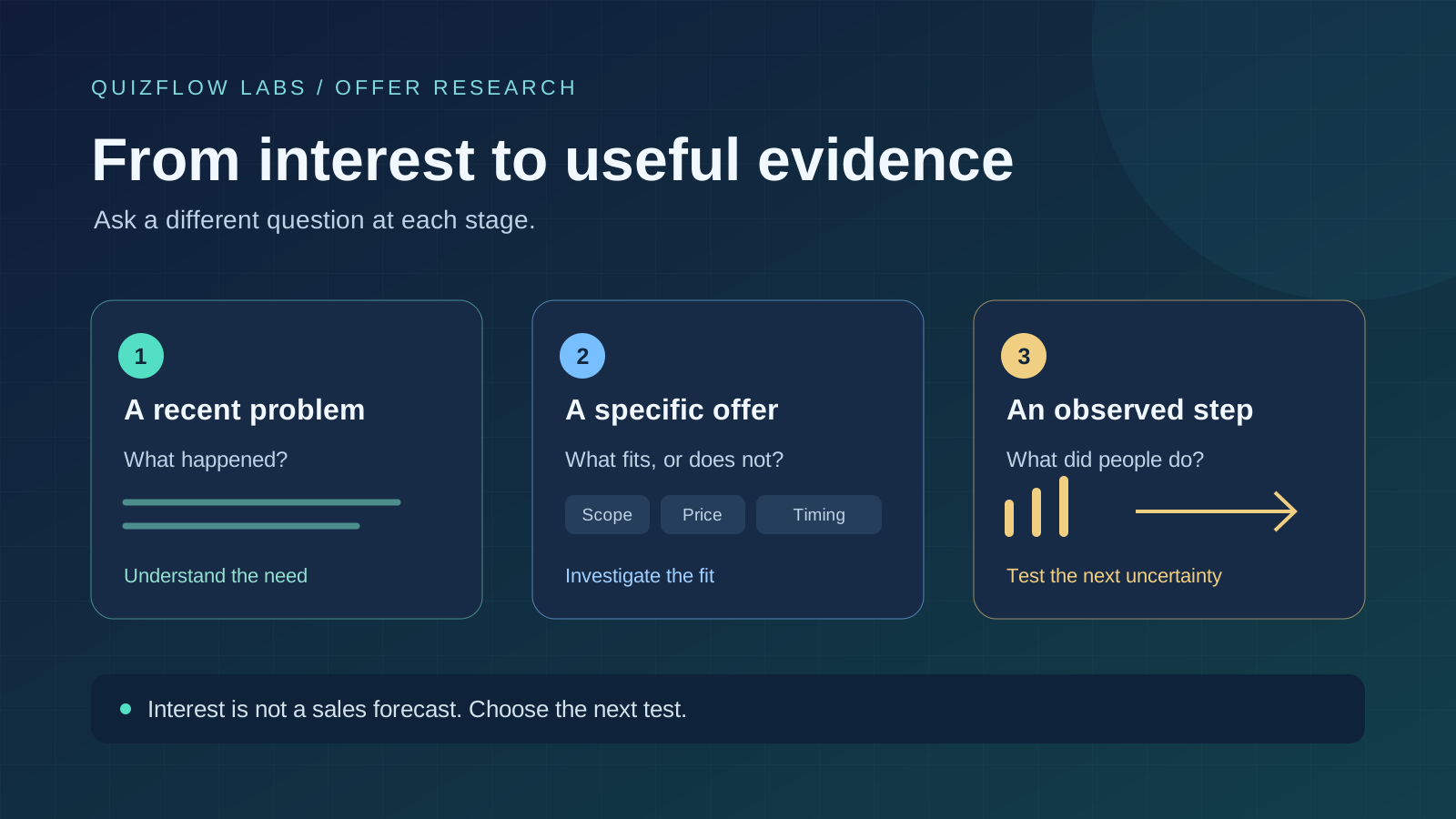
A demand survey should help choose the next test
A survey can help a creator or service business decide which offer deserves further testing. It can reveal a recurring problem, an unsatisfactory workaround or a constraint that makes an idea impractical. Those findings are useful even when the survey cannot tell you how many people will buy.
The risky shortcut is to ask whether an idea sounds appealing, count positive answers and turn that share into projected sales. Someone can like an idea without needing it soon, having the money to pay or preferring it to what they already use.
Treat the survey as a way to separate three questions: Is there a problem worth solving? Does this particular offer address it? What happens when someone can take a real next step? Each needs different evidence. Keeping them separate makes both positive and negative findings easier to act on.
Choose the decision before writing the questions
Define the audience, the uncertain assumption and the decision you will make. ‘Find out whether people like workshops’ is too broad. ‘Decide whether to test a live editing clinic for independent podcasters who already publish regularly’ names an audience and a manageable next investment.
Then identify what would change that decision. Evidence of repeated editing difficulties might justify exploring the problem. Evidence that people want feedback on their own recording might justify testing a clinic. Neither establishes that they will attend on a particular date at a particular price.
Recruit people who could plausibly use the offer. Existing customers, followers and people unfamiliar with the business can provide different perspectives; keep their answers distinguishable. A voluntary survey of followers describes the people who chose to reply. It does not become a forecast for the whole audience simply because the response count grows.
Read Strategyzer's guidance on designing strong experimentsOpens in a new tabAsk about the problem before presenting the solution
Start with a recent occasion the respondent can describe. Ask what they were trying to do, where it became difficult and what they did next. This gives you something more concrete to examine than a prediction about an unfamiliar offer. Strategyzer's experiment guidance recommends asking about past behavior rather than relying on opinions about future behavior.
Start with: ‘Thinking about the most recent episode you edited, what, if anything, was difficult to finish?’ If they describe a difficulty, follow with ‘What did you do to get past that?’ and, if relevant, ‘What did that approach leave unresolved?’ Ask one thing at a time. Include a way to say that nothing was difficult or that the person has not edited an episode, and leave out follow-ups that no longer apply.
Look for the work the answer describes. A repeated workaround that consumes time points to a different opportunity from an occasional annoyance with an easy fix. A person who has not sought help may be satisfied, unable to find it or unable to afford it; their answer alone does not tell you which. Use a short follow-up to distinguish those explanations.
Ask these questions before showing the proposed clinic so respondents can describe the problem in their own terms. The aim is to learn which needs actually exist, including ones your idea would not solve.
Example: make the offer concrete enough to reject
Consider a hypothetical podcast educator deciding whether to run an editing clinic. The concept shown after the problem questions is specific: ‘A live, 90-minute online clinic for people who have already edited at least one episode. Bring a short recording for feedback on editing decisions. Six places, $60 CAD per person, on December 8, 2026, from 7 to 8:30 p.m. Eastern. This is a concept under consideration; no booking is being taken in this survey.’
That description exposes the actual tradeoffs: a live session requires availability, bringing a recording requires preparation, and feedback is different from having someone edit the episode for you. ‘Affordable expert support for better podcasts’ hides those decisions and gives respondents too little to assess.
After the concept, ask: ‘Which part, if any, would help with the difficulty you described?’ Then ask: ‘What, if anything, would prevent you from taking part on these terms?’ Written answers can reveal a need for a different service. A short fixed-choice question about the stated date can separate scheduling conflicts from objections to the clinic itself.
Keep rejection easy. ‘This would not help with my current needs,’ ‘I need more information’ and ‘The idea fits, but the stated date does not’ have different meanings. Avoid combining them into one negative answer, or combining every favorable answer into ‘ready to buy.’
Use price answers to investigate constraints
If paying is part of the offer, show a realistic price alongside the scope and format. An interest question about a free resource does not test interest in a paid clinic. Likewise, an acceptable price for done-for-you editing says little about an offer that requires the customer to do the work.
A price objection is a starting point for diagnosis. Ask what the respondent compared the offer with and what they expected to receive. The problem might be an unaffordable amount, unclear scope, low urgency or a preferred alternative. Lowering the price before understanding the objection can leave the underlying mismatch intact.
Research gives a reason for caution about hypothetical prices. Schmidt and Bijmolt's meta-analysis of 77 studies found that hypothetical willingness-to-pay measures tended to exceed real measures, with differences across methods and contexts. It concerned consumer goods and services, rather than a forecast for any particular creator offer. Do not borrow an average adjustment from such research to convert survey answers into expected purchases.
Use a stated willingness to pay to choose what to investigate next. A genuine purchase under clear terms provides different evidence from saying that a price seems reasonable. Even purchases in a small pilot establish demand for that offer among those reached, rather than proving a larger launch will work.
Read the original willingness-to-pay meta-analysisOpens in a new tabMatch the next action to the uncertainty
Choose an action that tests the next unresolved question. If you do not yet understand the editing problem, invite a research conversation. If the format is uncertain, offer a clearly described sample session. If the question is paid demand, a real paid pilot you can deliver is more directly relevant than another enthusiasm rating.
Keep the meaning of each action intact. Joining an update list shows willingness to receive an update. Reserving a free sample shows willingness to reserve it; attending shows something further. None of these is a purchase. A click toward a booking page is also different from a completed booking.
The more demanding action can cost more to arrange and exclude people who cannot take it now. A quiet pilot invitation may reflect timing or a difficult booking process as well as weak demand. Check that people understood the offer and could complete the action before concluding that the concept failed.
Explain the action honestly. If the offer is still being explored, say so. If contact details are optional, make that choice clear and explain the follow-up. Someone should be able to decline without having their earlier feedback treated as invalid.
Read combinations of signals, rather than one interest score
Repeated problems plus weak interest in the concept suggest that the proposed solution needs investigation. Revisit scope, format and existing alternatives. For the clinic, respondents who want someone else to finish their edits may have a real problem that a teaching session does not address.
Strong stated interest plus little follow-through calls for a different check. Confirm that the invitation reached the intended people, that the date and price were visible, and that the next action worked. Ask a few people who declined what stopped them. These checks help distinguish offer objections from practical obstacles; they do not prove a single cause.
If regular publishers describe an urgent need while beginners express general curiosity, review those groups separately. A modest overall response can hide a useful narrower audience. Keep counts beside the descriptions, especially with small groups, so one or two answers do not acquire the authority of a market trend.
Record the offer version, audience source, invitation period and observed action. If you calculate a follow-through rate, state the denominator: for example, completed pilot bookings among identifiable people who received that exact invitation. Do not divide bookings by all survey respondents when only some received the offer. If exposure cannot be established, report the observed count and that limitation.
Build the research flow around what you need to learn
In QuizFlow Labs, use Text Response when you need the respondent's own account of a difficulty or workaround. Use Multiple Choice for a defined question such as whether they have edited an episode or can attend a stated date. Multiple Choice starts in single-select mode; use multiple select only when several answers can truthfully apply.
Keep the sequence purposeful: relevant experience, recent problem, current approach, a clearly labeled concept and the reason it does or does not fit. Read the written explanations alongside the choices. A structured response makes answers easier to compare, but it cannot establish that someone understood the offer or will buy it.
Before sharing, have someone from the intended audience explain the concept back to you. Check what they think they would receive, pay and need to prepare. If those expectations differ from the offer, correct the description before collecting more opinions about it.
Make the smallest decision the evidence supports
Finish the research by writing one decision and its reason: investigate the problem further, revise the concept, test a limited offer or stop work on this version. Name the uncertainty that remains and the next observation that would help resolve it.
A useful demand survey does not have to certify a launch. It earns its place by preventing an avoidable investment or making the next experiment more specific. Start with one audience and one offer, learn why people respond as they do, and keep the difference between interest and action visible.
Turn answers into a useful next decision
Build a focused offer-research flow
Use QuizFlow Labs to ask about real needs, collect clear explanations and explore which next step deserves a test.
Create your first flow