

How to Explain a Recommendation Quiz Result
A useful result explains why an offer fits, where that conclusion stops and what to check next. Build an explanation that helps someone judge the recommendation rather than simply accept it.
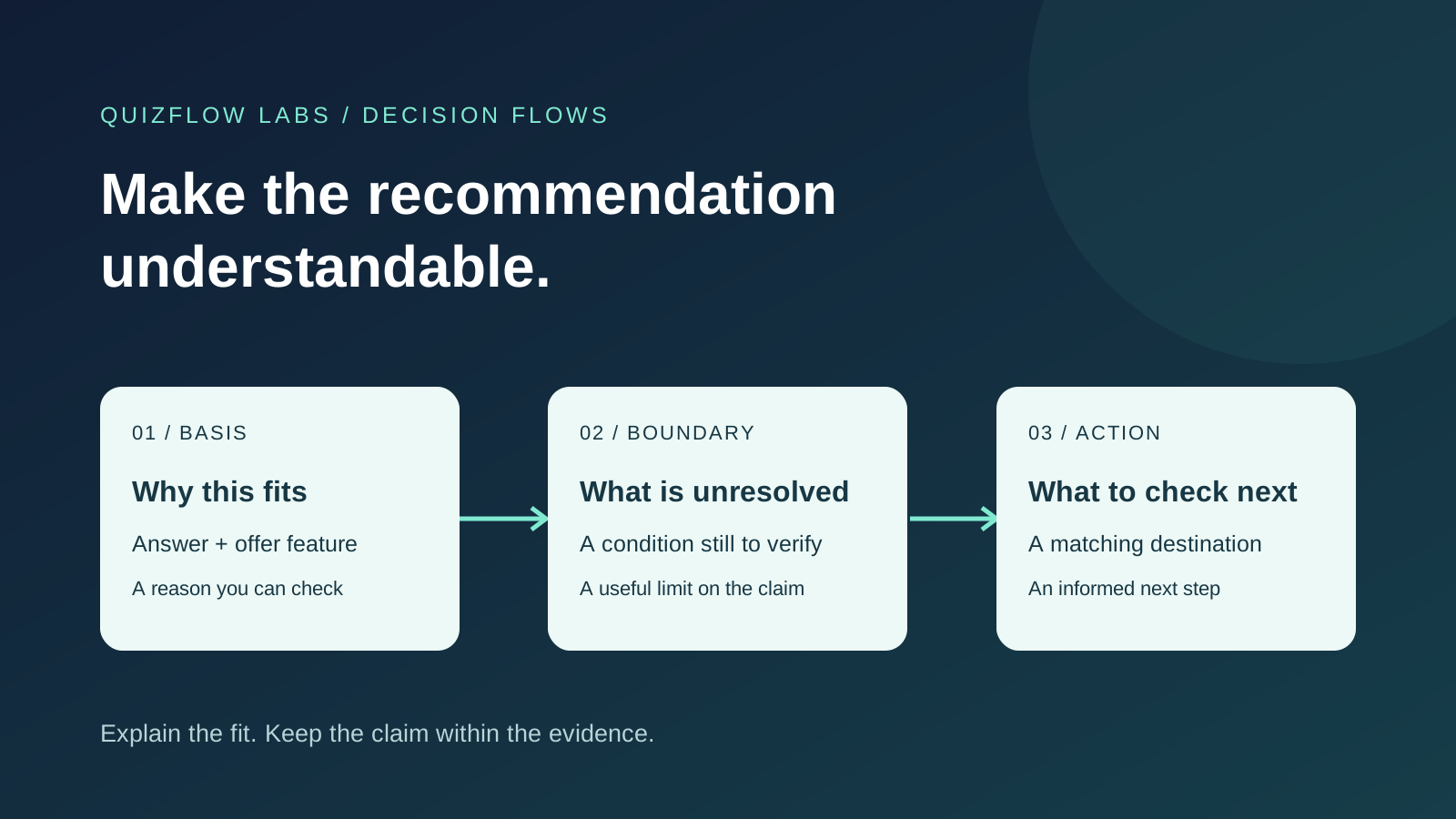
The result needs a reason someone can evaluate
A recommendation quiz result is a small decision aid. Naming an offer tells someone where to look; explaining the fit helps them decide whether to act. A result can be easy to read and still fail this task if its explanation could accompany every offer in the catalogue.
The useful question is not “How can we make this sound more personalized?” It is “What does this person need to understand before choosing the next step?” Usually that means the relevant answers, the feature of the offer those answers support and any unresolved condition that could change the decision.
Keep the claim proportional to the information collected. A short business quiz can suggest a suitable starting point among the offers you included. It does not establish that this is the best option on the market, verify someone’s skills or guarantee the result of buying it.
Connect the actual selection reason to a useful difference
Begin behind the result screen. For each possible recommendation, write down what actually selects it: a particular answer, a combination of requirements or a score range. Then identify the difference between that offer and its nearest alternative. An explanation needs both pieces. Repeating an answer without connecting it to the offer is a summary, not a reason.
For example, a preference for feedback on a draft matters if one service includes individual review and the alternative is self-study. Saying “You value quality” adds little: it neither explains the choice nor distinguishes the offers. Say what the review provides and why it addresses the stated need.
Do not invent a more flattering reason after the selection has happened. If a result is determined by a budget answer alone, copy saying someone’s advanced expertise caused the recommendation would misrepresent the decision. Even an answer you genuinely collected is not a selection reason if it played no part in the choice. Either narrow the explanation to the real reason or revise the selection method before writing the result.
NIST’s principles for explainable AI distinguish an understandable explanation from one that accurately reflects the process that produced the output. That distinction also offers a useful test for an ordinary rules-based quiz: a convincing story is not enough if it describes a different decision.
Read NIST’s principles for explainable AIOpens in a new tabWrite only what is true for everyone who can receive the message
A result may be shared by several answer combinations. Check the explanation against all of them. “You asked for live feedback” is inaccurate if some people reach the same result because they chose help with planning but never requested feedback.
One option is to use a broader explanation that remains informative: “This session provides guided planning and individual feedback on a draft.” This describes the service without pretending every recipient gave the same answer. Add the connection to fit only where the selection criteria support it. Another option is to create genuinely distinct result messages where those criteria justify them.
The tradeoff is specificity versus maintenance. A shared explanation is easier to keep accurate but may explain less about an individual’s route. More variations can make the reasoning clearer, but each variation needs its own checks when questions, rules or offers change. Add a variation when it clarifies a meaningful difference in fit, rather than merely echoing a different word.
Pay particular attention to fallback results. If no specific recommendation condition was satisfied, do not use copy that implies a strong match was found. Explain the limited conclusion and offer a suitable way to clarify the need.
Separate a supported fit from an unanswered condition
Identify what the quiz has not established. An offer may match the requested type of help while its timetable, price or required starting material remains unconfirmed. Include a limit when it matters to the next decision, and make it actionable.
“Check the session dates before booking” is useful if attendance is essential and the quiz did not ask about availability. A vague disclaimer such as “Results may vary” does not tell someone what remains to be checked. Equally, a long list of irrelevant uncertainties can obscure an otherwise straightforward choice.
Do not turn a score into a probability without evidence that supports that interpretation. An internally assigned score of eight out of ten is not automatically an 80% chance of success or an 80% match. If the number only organizes answers into recommendation bands, plain language about the band’s actual meaning may be more useful than displaying the number.
Microsoft’s Human-AI Experience Toolkit recommends making explanations available for AI outputs and cautions against overreliance. If AI helps draft your result copy, check each reason against the real inputs and selection process. Fluent language does not establish that the recommendation or its explanation is correct.
Read Microsoft’s guidance on explaining AI behaviorOpens in a new tabAn example: recommend feedback without promising finished work
Consider a hypothetical creator offering a self-paced proposal-writing course and a live proposal review. The quiz asks what help the visitor wants and whether they have a draft. In this example, a request for feedback plus an existing draft selects the review; wanting to learn the process selects the course. Availability is checked separately before booking.
A weak review result would say: “You’re a confident communicator. Our premium review is your perfect match. Book now to win more clients.” The answers do not establish confidence, a perfect fit or future sales. The copy also fails to explain what the review actually does.
A more useful result is: “Start with a proposal review. You said you have a draft and want feedback on it. The live review focuses on the structure and wording of that draft, so it suits a revision task. You will make the edits yourself; this is not a proposal-writing service. Check the session dates and price before booking.” The action label is “See review details and dates.”
The reason connects two actual answers to a service feature. The boundary distinguishes feedback from done-for-you writing, which could otherwise be an expensive misunderstanding. The action leaves an unverified condition open instead of presenting the quiz as booking approval.
If the same review result can also appear when someone has no draft, this explanation fails. Fix the selection or write a separate, appropriate message; do not weaken the sentence until it says nothing. If no available offer serves that person’s need, provide clarification rather than dress an unsuitable offer in reassuring copy.
Test whether the explanation survives changes in the answers
Take one representative path to each result and record the answers, the actual reason for selection, the displayed explanation and the next destination. Read them together. Can you point to support for every statement about the participant? Does the offer really provide the feature named in the explanation?
Next change the answer that should distinguish this offer from its closest alternative. Check whether the selection and explanation change appropriately. Then change an answer that should not affect the recommendation. The explanation should remain true even if the result stays the same. These paired cases expose copy that mentions incidental answers as if they caused the decision.
Also test a less obvious combination that reaches the same result, plus an uncertain or unmatched path. This is especially important for score bands: different combinations can produce the same total while supporting different descriptions. A few example paths are a starting point, not proof that every possible combination is covered.
Ask someone unfamiliar with the flow to explain the result in their own words: Why was this suggested? What does it include? What still needs checking? What will the button do? If they repeat the offer name but cannot explain the fit, add the missing connection. If they infer a promise you did not establish, narrow the wording.
Interpret problems at the right layer. A sensible offer with a false reason needs corrected explanation copy. A truthful reason leading to an unsuitable offer needs a change to the selection criteria or catalogue. A clear result followed by an unrelated sales page needs a better destination. More persuasive wording cannot repair those last two problems.
Put the explanation and action together in QuizFlow
In QuizFlow Labs, use Outcomes to prepare the result title and message, then configure its next action. Write the offer name and useful fit explanation before polishing the button label. The title, body and action should describe the same next step.
When conditional outcomes are part of the flow, inspect the message and action that actually appear for each tested path. Do not assume changing a result message also changes its destination. Follow the action as part of the review, and check the destination’s description of scope, price and availability against the result.
Keep your working selection notes outside the public explanation. The visitor needs a readable reason and the important limit, not internal rule names or an account of every test you performed. Return to the test cases whenever an offer or a selection condition changes.
Use the QuizFlow Outcomes guideMake the next decision easier
Start with one result that matters to your business. Write its actual selection reason in plain language, connect that reason to an offer feature and identify the unresolved condition that matters most before acting. Remove every claim the answers or the offer cannot support.
Then check another path to the same result and one path to a nearby alternative. If the explanation remains accurate and a reader can judge the fit, the result is doing useful work. A recommendation earns its place by helping someone make a decision they can understand.
Turn answers into action
Build a recommendation with a clear next step
Create a QuizFlow decision flow that connects the questions you ask to an outcome people can understand and act on.
Create your first flow