

What Time Period Should a Customer Survey Ask About?
Choose between one recent experience, a fixed calendar period and a rolling window so customer answers mean what you think they mean.
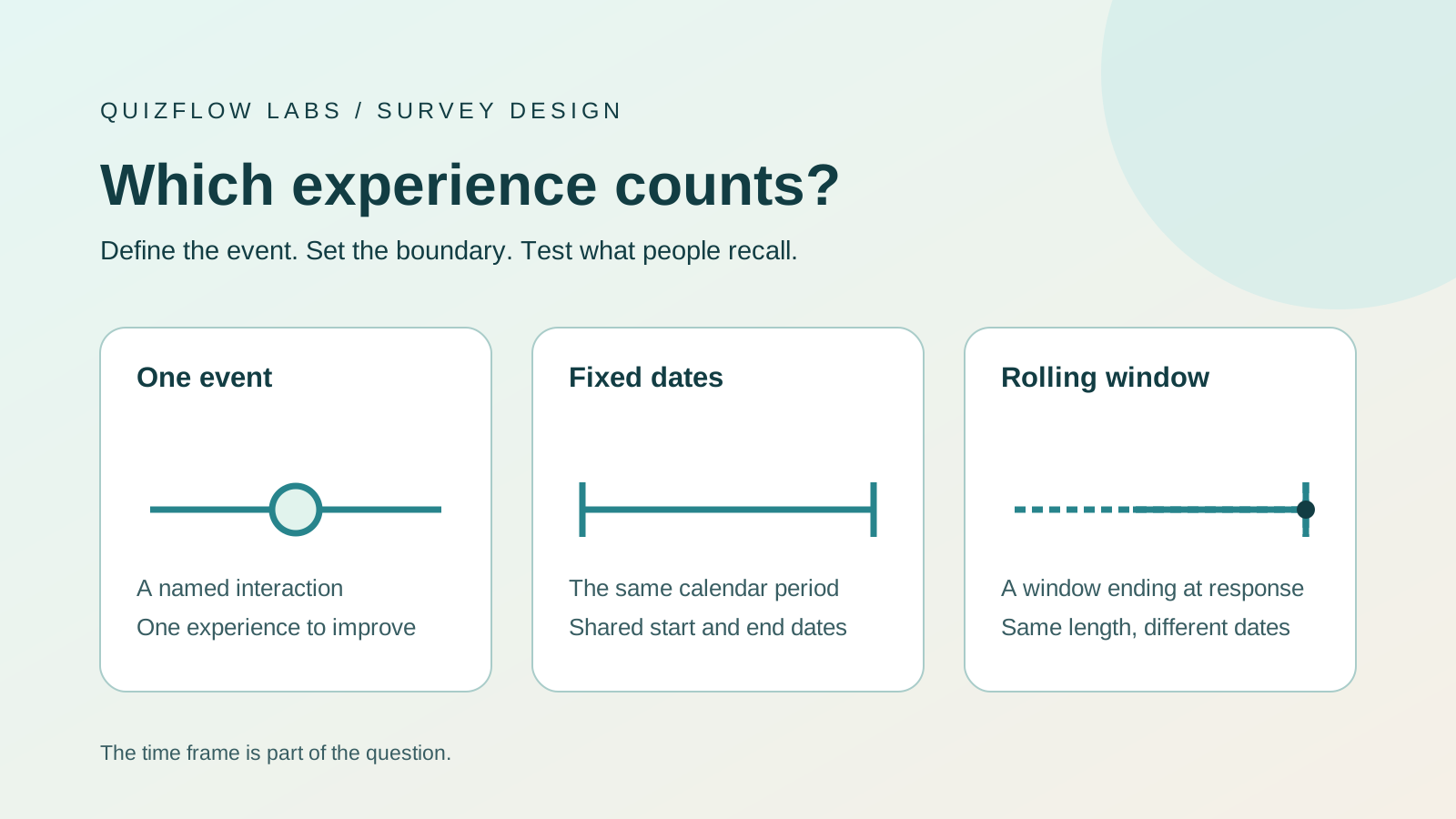
Choose the experience before you choose the dates
A customer survey needs a clear time frame because an answer about one interaction means something different from an answer about a whole relationship. A frustrating support exchange last week can coexist with a useful year of service. If the question leaves the period open, the rating alone cannot tell you which experience someone judged.
Start with the decision you want the answers to inform. To improve a particular appointment, ask about that appointment. To understand use during a billing month, ask about that month. To understand recent activity among people who arrive at a survey on different days, consider a rolling window such as the seven days before they answer. Choose the shortest period that still covers the experience relevant to your decision.
Also decide what counts as an event. Opening a course lesson, completing it and applying it to paid work are different behaviors. A precise period cannot rescue an undefined activity. Write the behavior and period together before writing the answer choices.
Use one named event for a specific improvement
An event-based question works when the thing you can change belongs to an identifiable interaction: a consultation, a delivery or a support exchange. Name the event clearly enough that someone with several recent interactions knows which one you mean. Ask about what could have happened by the time you send the survey.
For a course creator, feedback immediately after a lesson can inform clarity and navigation. It cannot yet establish whether someone used the lesson successfully in their business. That needs a later question and enough opportunity to try the method. Sending a survey sooner protects freshness, but sending it before the relevant experience is possible measures the wrong thing.
An event-based survey also changes what the results represent. If every purchase triggers an invitation, frequent buyers have more opportunities to contribute than occasional buyers. Decide whether the report describes transactions or individual customers, and explain that basis when presenting it. Do not describe transaction feedback as the views of every customer.
Choose fixed dates or a rolling window deliberately
A fixed period gives everyone the same dates, such as 1–31 October. Use it when the question concerns a named launch, a reporting month or a shared program phase. The drawback is that someone answering late must remember farther back. Keep the invitation schedule consistent if you plan to repeat the survey.
A rolling window gives each respondent the same length of time but different dates. “In the seven days before today” can suit an always-available feedback flow. Answers collected weeks apart may then describe different product versions, promotions or service conditions. Keep the response dates with your analysis so you can identify that difference.
Avoid “last month” when it could mean either the previous calendar month or the previous 30 days. Duke University’s recall guidance uses this kind of ambiguity to explain why explicit time references matter. A fixed-date survey also needs maintenance: update the dates and invitation together before reusing it.
Duke guidance on helping respondents recall eventsOpens in a new tabMatch the detail to what people can remember
Choose a window by considering event frequency, how distinctive the events are and the detail you need. Counting every small interruption over several months is a different memory task from remembering one major purchase. If you need exact totals, consider whether customers can consult a record or whether your decision can use a less precise answer.
The Australian Bureau of Statistics warns that people can place an event inside a survey period even when it occurred outside it. Its guidance recommends shorter reference periods where possible and testing whether respondents can recall the requested information. Clear dates help define the boundary; they do not guarantee accurate recall.
For a business deciding whether customers used a resource at all, an initial yes-or-no question may be sufficient. If the decision depends on frequency, a count or sensible frequency bands may be necessary. Bands reduce the precision requested, but they do not make a forgotten event recoverable. “I cannot remember” should remain distinct from “None” when both are plausible.
Asking about a “typical week” serves another purpose: it asks people to summarize a pattern rather than report a particular week. That may suit a broad description of habits. It should not be interpreted as a measured count for the most recent seven days.
ABS guidance on question structure and memory biasOpens in a new tabExample: a creator wants to improve a resource library
Consider a hypothetical creator who wants to decide whether to improve the examples inside a proposal resource library. “How useful is the library?” leaves open whether members are judging its appearance, a recent download or work they completed months ago. The creator instead needs feedback from members who tried a resource on a real proposal.
For an October review, the first question is: “Between 1 and 31 October, did you use a resource from the library while preparing a proposal?” The choices are “Yes,” “No” and “I cannot remember.” A member who downloaded a template but did not use it on a proposal answers No. That boundary belongs in a short instruction beside the question.
Members who answer Yes can be asked how useful the resource was on the most recent proposal they used it for during those dates, using a balanced scale from very unhelpful to very helpful, plus a separate cannot-judge option. A follow-up asks which part helped or got in the way. Restricting the follow-up to the most recent qualifying proposal gives the explanation a specific reference; it does not summarize every use that month.
A No answer is not a poor usefulness rating. If the creator also needs to understand non-use, a separate question can ask why they did not use it, with options for having no proposal to prepare, not finding a suitable resource and another reason. Those answers distinguish lack of opportunity from a possible content gap. They do not prove that adding examples will cause more use.
Test the boundary, then diagnose the first mismatch
Before launch, ask a few people similar to the intended respondents to explain the question in their own words. Ask which dates they included, which event they thought of and how they arrived at the answer. Include someone with no qualifying experience and someone with several. The goal is to discover interpretation problems, not to estimate a population rate from a small test.
Use boundary cases as well as easy ones. For the library example, describe use on 30 September, a download without use in October, and two uses during October. Ask what the person would select and why. If September is included, clarify the period. If a download counts as use, clarify the behavior. If someone cannot choose which of two uses to describe, clarify the event-selection instruction.
If people understand the boundaries but cannot reconstruct a count, change the recall demand or consult an appropriate record rather than adding more instructions. If they answer confidently but describe the wrong experience, fix the event label. These are different failures and need different corrections.
Report the base and preserve the meaning over time
Report no experience, cannot remember and usable ratings separately. For the library example, calculate the share finding the resource useful among respondents who reported qualifying use and gave a usefulness rating. Define which scale categories count as useful before analyzing the results, and show both the useful count and the total number of ratings. Report cannot-judge answers separately rather than treating them as neutral ratings. Also report how many respondents reported no use or could not remember, using all respondents who answered the initial use question as that denominator.
A high usefulness rating with few qualifying users tells you something about the people who used and rated the resource. It does not establish broad adoption. A large cannot-remember group can signal that the task is difficult, but it can also reflect an unclear question. Check a few explanations before deciding to shorten the period.
Keep the behavior definition, window length and invitation timing stable when comparing rounds. Moving from seven days to 30 days gives people more opportunity to report an event, so a larger share reporting any use is not sufficient evidence that use increased. If the question must change, label the change and start a new comparison series rather than silently joining the results.
Put the time frame into the flow
In QuizFlow Labs, a Multiple Choice block in Single select mode can capture one response such as Yes, No or I cannot remember. Include the period in the question itself so it is visible where the decision is made. Keep the follow-up wording equally specific about which experience to describe.
Start with one decision, one defined behavior and one defensible period. Test the no-experience and uncertain cases before sharing the flow. That preparation makes the answers more useful for deciding what to investigate or improve next.
Configure a Multiple Choice blockQuizFlow Labs
Ask about an experience you can act on
Build a feedback flow with clear questions and a useful next step for respondents.
Create a feedback flow