

What Should a Recommendation Quiz Do When Nothing Fits?
A useful recommendation quiz needs a credible answer when no offer fits. Separate firm limits from missing information and flexible preferences, then give each visitor a next step that makes sense.
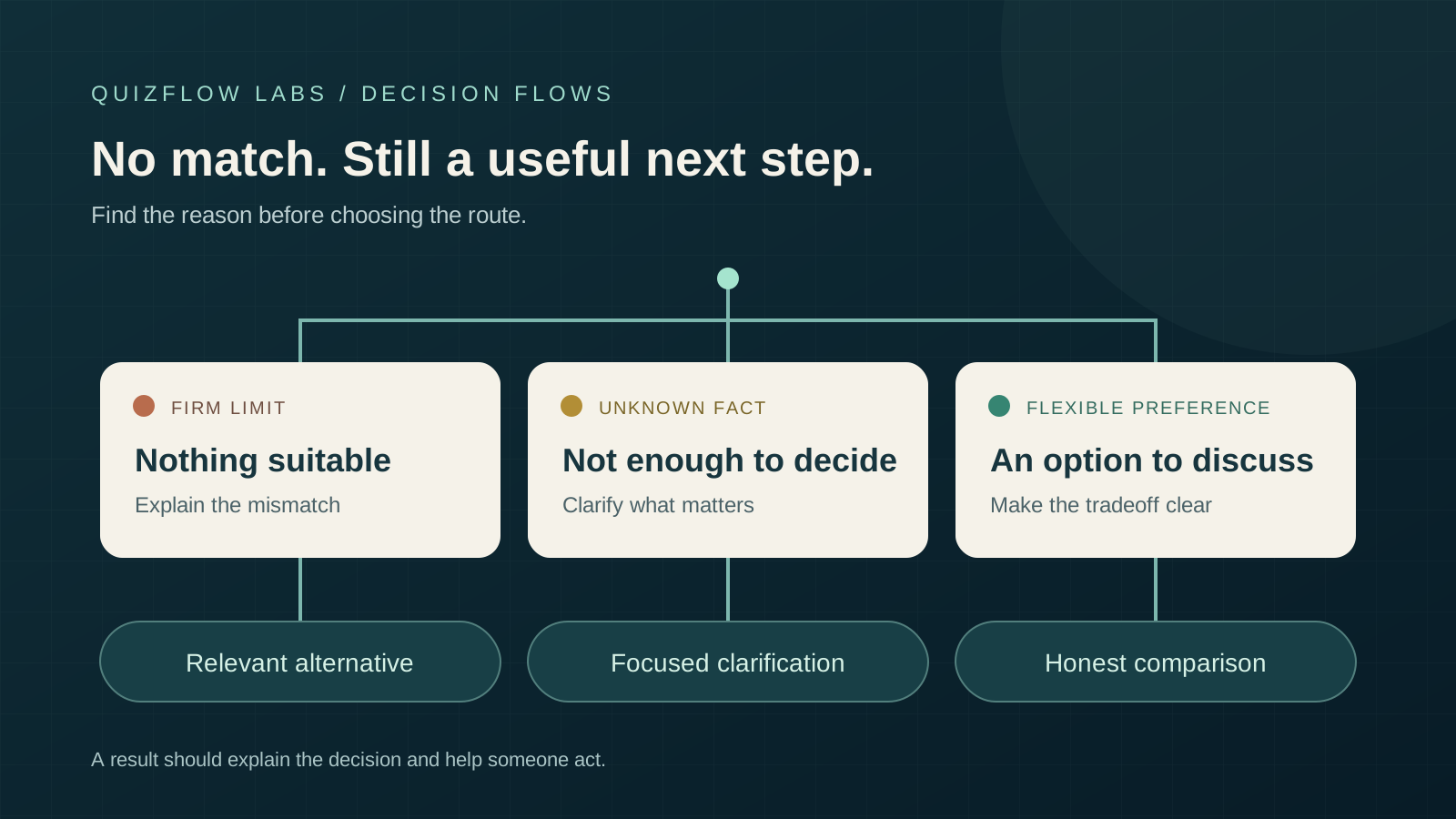
No match is a result worth designing
A recommendation quiz should help someone decide whether an offer suits their needs. That includes recognizing when none of the available offers works. If every completed quiz must produce a product or package, the result can look personalized while ignoring the very answers that should rule an offer out.
For creators and service businesses, this is a practical design problem. A course may require prior experience. A service may cover only certain work. A delivery deadline may be impossible. A visitor who reaches one of those limits still deserves a clear explanation and a useful next action.
Design the no-match path alongside the successful recommendation. First establish why a match cannot be made. Then decide whether the visitor needs an alternative, a clarification or help comparing an acceptable compromise. Those are different decisions, and one generic booking button cannot explain all three.
Separate a firm limit from a preference
A firm limit makes an offer unsuitable even if everything else looks attractive. A workshop that requires participants to bring a finished draft cannot serve someone seeking help writing their first draft, unless the workshop actually includes that preparation. Extra points for preferred format or budget do not remove the missing prerequisite.
A preference helps choose among offers that could work. Someone might prefer individual coaching but be willing to attend a small group. The quiz should not assume that flexibility, but it can ask about it. Treating every preference as a firm limit creates unnecessary dead ends; treating every limit as a preference creates misleading recommendations.
For each offer, write down the few facts that make it unusable, why they matter and what would have to change for it to become suitable. Keep these rules tied to the actual service. A package name or an arbitrary score is not a reason to exclude someone. Put simple, universal requirements on the opening page rather than making people complete a quiz to discover them.
Do not confuse an unknown answer with a failed requirement
“I do not meet this requirement” and “I do not know whether I meet it” support different conclusions. The first can rule out an offer. The second leaves the decision unresolved. If a quiz treats both as no, it may turn away suitable visitors; if it treats both as yes, it may recommend something without enough evidence.
Ask one clarifying question when the answer would genuinely settle the decision. Explain an unfamiliar requirement or show what to check. If clarification requires reviewing a document, leave the person with a specific preparation step. If it requires professional judgment, offer a focused inquiry rather than pretending another multiple-choice question will resolve it.
Use human review only when someone can actually make that judgment. Define what the reviewer will check and what the visitor should provide. A general sales call is not a useful fallback if the team already knows it cannot deliver the requested service.
Choose a next step that addresses the reason
A useful no-match outcome connects three things: the need the visitor described, the limitation that prevents a recommendation and the action that could help. Keep the explanation specific enough to make the decision understandable without reproducing the entire questionnaire.
For a firm mismatch, point toward a genuinely relevant resource or another route if one exists. For a missing fact, explain how to find it or request a focused review. For a flexible preference, ask whether an explicitly described alternative would work. If there is no useful alternative, a clear explanation is better than an unrelated offer.
These actions have costs. Human review consumes time, so reserve it for cases where judgment could change the answer. A self-service resource needs to help with the stated obstacle. An alternative package needs an honest account of what the person gives up. The next step should resolve the problem that stopped the recommendation, rather than simply keep the funnel moving.
An example: a presentation coach with three offers
Consider a hypothetical presentation coach offering a self-paced planning course, a group rehearsal workshop and an individual presentation review. The workshop and review both require a complete draft. The workshop runs on fixed dates; individual reviews require five business days. The planning course helps people develop a draft but does not provide personal feedback.
A visitor wants individual feedback on a presentation due in two business days. They already have a draft. Neither the group workshop nor the review meets the stated need and deadline. The planning course is available immediately, but availability alone does not make it a match: it does not deliver the requested feedback.
The result could say: “We cannot provide individual feedback before your two-business-day deadline. Our individual review requires five business days. The rehearsal guide below can help you review the presentation yourself, but it does not include personal feedback.” A primary link labeled “Use the self-review guide” matches that explanation. This is a useful fallback only if the coach has a guide that actually supports that task.
Now change one fact. If the visitor says the deadline is flexible, ask whether five business days would work before recommending a review. If they do not know whether their draft is ready, explain what a complete draft includes. The same offer catalogue produces three different next steps because the obstacle is different.
Write the result as guidance, not an error message
A valid answer can reveal that your service is unsuitable. That does not mean the visitor entered something incorrectly. GOV.UK’s validation guidance makes this distinction explicitly: eligibility decisions belong on an explanatory page, while validation messages help people correct unusable input.
For a business quiz, avoid “Invalid choice” or “You failed to qualify” when the person has accurately described their needs. Name the offer’s limitation instead: “This workshop assumes you already have a complete draft.” That gives the visitor information they can use without making a judgment about their ability or seriousness.
Make the action equally clear. “See what a complete draft includes” explains more than “Continue.” If someone may have misunderstood a question, give them a way to review or correct the relevant answer where the flow supports it. Do not encourage people to change a true answer merely to unlock an offer.
Set up the outcome carefully in QuizFlow Labs
QuizFlow Labs supports a default outcome and conditional outcomes with their own messages and actions. Use the default as a useful, cautious ending for cases that do not meet a specific outcome rule. A default that always promotes a package can turn an unhandled answer combination into a recommendation by accident.
Conditional outcomes can match variables, an active intent or a score. Variable-match rules run before intent rules, which run before score rules; the first matching rule within that evaluation order wins. When a flow records a decisive constraint in a variable, a variable-match outcome can explain that constraint before a general score-based recommendation is considered. Configure and test the variable explicitly: writing a condition does not make the underlying fact available.
Check the action as well as the message. A matching conditional outcome with no replacement actions keeps the default actions. If the default action invites a purchase or booking, a no-match message alone does not remove it. Give the conditional outcome an appropriate replacement action, and inspect the final result in preview.
Keep the design small enough to verify. Start with one decisive limitation, one clear explanation and one relevant destination. Add more conditions only when they change the guidance. The objective is a dependable decision flow, not a large collection of exceptions.
Configure default and conditional outcomesTest the boundaries, not just the obvious matches
Before sharing the quiz, write a small set of fictional profiles and decide the appropriate result by hand. Include a clear match, one failed requirement, an unknown decisive answer, a flexible preference and a combination that matches no specific rule. Then run each profile through the actual preview and compare the message and action with your written expectation.
Change one answer at a time around important boundaries. In the coaching example, test the five-business-day deadline and a shorter deadline while holding everything else constant. Also test a strong preference score alongside a failed prerequisite. If the preference score still produces the package recommendation, the limiting condition is not governing the result as intended.
When a result is wrong, locate the failure before changing the copy. Was the question misunderstood? Was the answer stored in the expected variable? Did two conditions match? Did the default appear because no condition matched? Did the correct message keep the wrong CTA? Each explanation calls for a different repair. Rewording the result cannot fix a rule that selects the wrong outcome.
Interpret no-match patterns before changing your offers
Repeated no-match outcomes can reveal a question problem, a traffic mismatch or a real gap in the offer. Keep a simple record of the reason during your review, using only the information needed for that review. Do not collect extra contact details just to count how often a limitation appears.
If visitors repeatedly choose “not sure,” investigate whether the requirement is understandable before treating them as unsuitable. If people from one campaign consistently want a service you do not offer, check the campaign promise and destination. If clearly understood requests repeatedly fail the same real requirement, consider whether a new offer or a referral would be viable—but do not promise either before it exists.
Compare patterns with context. A greater share of no-match results after a campaign change may reflect a different audience rather than worse quiz design. A handful of cases can identify questions to investigate; it does not establish market demand or justify relaxing a requirement. Review the reasons and, where appropriate, ask people what they were trying to accomplish.
Start with the mismatch most likely to mislead someone
Choose one offer and identify the answer that should prevent you from recommending it. Decide whether that answer describes a firm limit, an unknown fact or a preference worth discussing. Write the explanation and choose the next action before adding the rule.
Then test that case alongside an ordinary match and an unhandled combination. Confirm that the message, destination and rule order agree. A recommendation quiz becomes more useful when every outcome—including no match—helps someone understand what to do next.
Turn answers into action
Build a decision flow with useful outcomes
Create a QuizFlow Labs flow that connects answers to clear guidance, relevant recommendations and sensible next steps when an offer does not fit.
Start building