

How to Review an AI-Generated Quiz Before You Publish It
A polished quiz can still ask the wrong questions or recommend the wrong offer. Review the facts, the decision behind each result and the finished experience before sharing it.
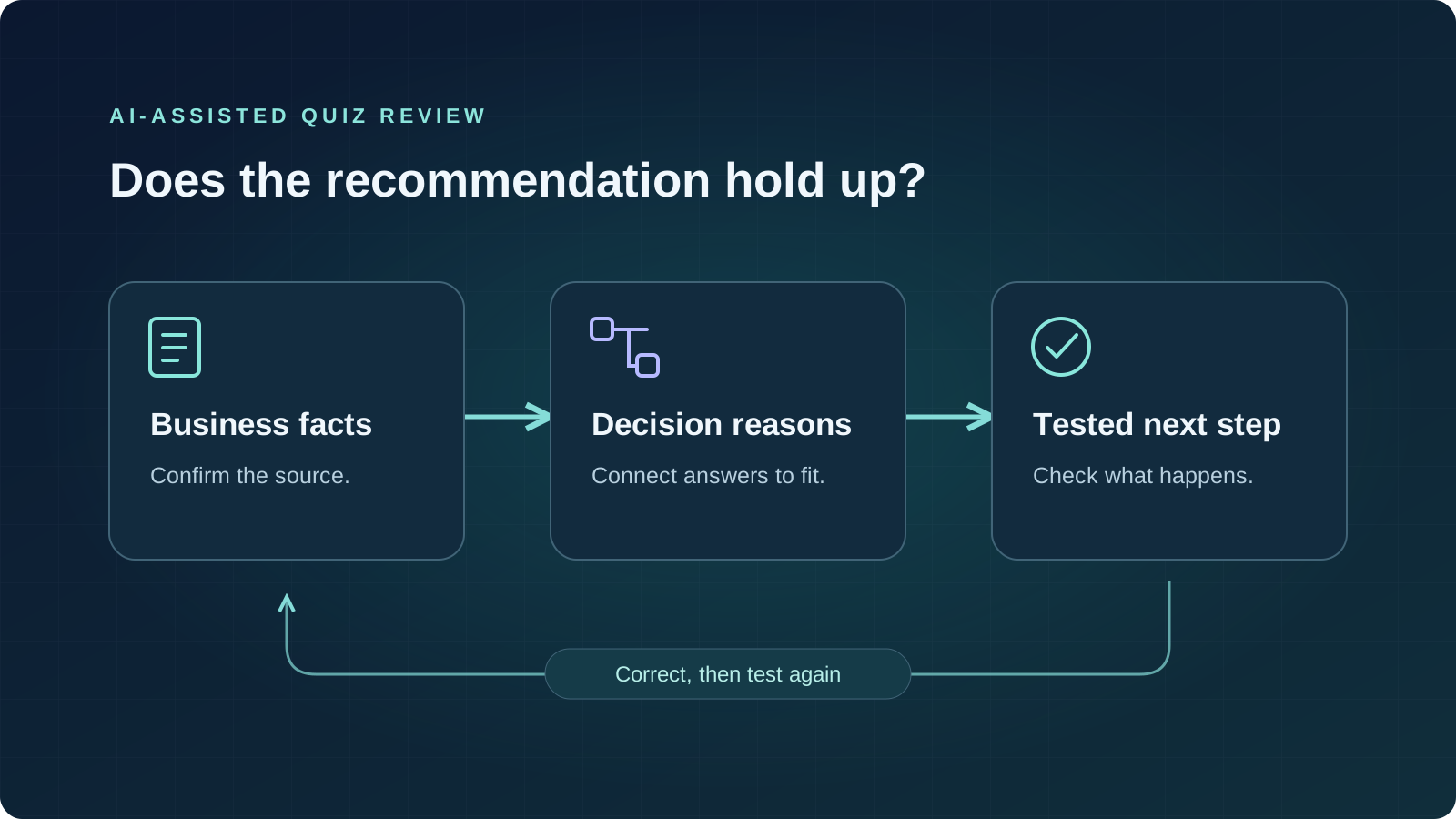
Review the decision as carefully as the writing
Reviewing an AI-generated quiz means checking whether it helps someone make a sound decision. Clear sentences and attractive result names matter, but neither establishes that the questions collect the right evidence or that the recommended next step fits the answers.
Generative AI can produce confidently inaccurate content, a risk described in NIST's Generative AI Profile. In a business quiz, an invented fact might be a course prerequisite, a package inclusion or a promise in the result message. A draft can also use entirely accurate facts but connect them through a weak decision rule.
Treat these as separate problems. Check facts against business information you control, inspect how answers justify outcomes, then test the corrected experience. This method applies to a fixed quiz drafted with AI; a live AI conversation needs additional testing of what it might say during each interaction.
Write the decision brief before judging the draft
A reviewer needs a reference that is separate from the generated quiz. Otherwise, a plausible question and a plausible result can appear to validate each other. Write down the decision the visitor needs to make, the available outcomes and the facts that distinguish them.
For an offer recommendation, use current offer descriptions and real requirements. Record which conditions rule an offer out, which preferences help choose among suitable offers and which facts may remain unknown. Decide what a visitor should receive when the information does not support a recommendation.
Keep the brief small enough to use. It might say: help a learner choose between a foundations course and a feedback session; the session requires a working project; format preference matters only after that requirement is met. The business owner must confirm those conditions. Asking AI to generate the brief as well as the quiz does not provide a separate check.
When no one can agree on what makes an outcome suitable, pause the wording edits. The unresolved work is an offer or decision definition. More fluent questions will not settle it.
Trace every consequential claim to its source
Read the introduction, questions, answer explanations, results and button labels for statements someone could act on. Check prices, included services, prerequisites, delivery times and availability against their current business source. Check the destination page too: a result should not promise one thing while its button opens another.
Distinguish a supported fact from a suggestion. A draft might suggest that a beginner course should include personal feedback. That can be an idea for a future offer, but it cannot become an inclusion in today's recommendation unless the business actually provides it.
Keep a short private record of the claim, its source and the correction. If sources conflict, resolve the business fact before publishing. Removing a decorative adjective is a copy edit; changing who qualifies for an offer requires revisiting the questions and results that depend on that condition.
Check what each answer actually establishes
For each question, finish this sentence: this answer tells us ___, which changes ___ in the recommendation. If the second blank has no useful answer, remove the question or move it to a later conversation. If the first blank claims more than the response reveals, narrow the conclusion or ask for the missing fact.
Self-reported confidence, for example, establishes how confident someone says they feel. It does not demonstrate that they can complete a task. A question about what they have already made may be more relevant when an offer requires an existing project. That answer is still self-report, rather than independently verified competence.
Inspect the wording and the control together. A question asking about both confidence and available time cannot explain which factor drove a mixed answer. Pew's question-writing guidance recommends asking about one concept at a time and using concrete language. Rewrite the question around the distinction the decision actually needs.
Check whether a person can answer truthfully without guessing. If several needs can coexist, either allow them to be expressed or explicitly ask for the priority relevant to this decision. An uncertainty option also needs a useful destination; adding 'Not sure' without deciding what it means only moves the ambiguity downstream.
An example: a course recommendation with an invented prerequisite
Consider a hypothetical course creator offering Foundations, a self-paced introduction, and Feedback Lab, a session for people who can bring a working draft. The actual prerequisite for the lab is that draft. There is no minimum number of years of experience.
An AI-generated quiz asks how long someone has been creating, how confident they feel and whether they prefer live help. It sends confident creators with more than a year of experience to Feedback Lab. The wording sounds reasonable, but the quiz never establishes that they have something to review.
Correct the decision before polishing the result. Ask whether a working draft is available. A confident creator without one should not receive an immediate lab recommendation. A new creator with a draft should not be excluded simply for being new. Live-help preference can help distinguish suitable next steps, but it cannot replace the prerequisite.
When the learner requests feedback and has a working draft, the result can explain that Feedback Lab fits that request. Having a draft alone does not establish a desire for feedback. The explanation should not declare the learner 'advanced' or promise that the session will produce a successful launch. The first claim exceeds the evidence collected; the second adds an outcome the offer cannot guarantee.
If someone is unsure whether their draft is ready, explain what the session needs and offer a way to clarify readiness. That costs more attention than an automatic recommendation, but it avoids treating an unknown fact as a confirmed fit.
Test expected outcomes without copying the generated logic
Write test cases from the decision brief before looking at the configured result. For each case, record the relevant facts, expected outcome and reason. Then enter those answers in the finished quiz and record what actually appears. A test that derives its expected answer from the same generated rule can repeat the rule's mistake.
Use contrasting cases that isolate an important condition. In the course example, compare a new creator with a working draft against an experienced creator without one. Then test an uncertain answer, conflicting preferences and a request neither offer serves. These cases expose assumptions that a straightforward ideal-customer path may never touch.
When a quiz uses points, inspect the meaning of the total as well as the arithmetic. A high preference score should not cancel a firm prerequisite. A threshold chosen by the generator needs a business rationale; successful calculation alone does not establish that it separates appropriate recommendations.
Test the result message and actual button destination together. Change an earlier answer and check the revised result. After a correction, rerun both the failed case and previously correct cases that depend on the changed question, condition or result. Keep the cases with the reviewed revision so another regeneration does not erase what you learned.
Use observed problems to choose the right repair
Different failures need different fixes. Rewriting everything with another prompt can hide the cause and introduce fresh assumptions. Preserve the current version, identify the failed claim or decision and make the smallest change that resolves it.
People interpret a question differently
Probe what they thought it meant. Clarify the concept or split it only when both parts are needed; changing a result threshold will not repair an ambiguous input.
Clear answers produce an unsuitable result
Compare the outcome with the brief. Look for a missing prerequisite, an unjustified score or a condition that groups unlike situations together. Repair the decision, then retest its dependent paths.
The result fits, but the explanation overclaims
Remove unsupported labels and promises. Explain the relevant answers and offer conditions without claiming to measure expertise, personality or future success.
The explanation fits, but the next step fails
Check the destination, its offer details and the action it actually allows. A working link is insufficient if it leads to a different service or an unexpected commitment.
Observe likely users attempting a realistic task without telling them which answer to choose. Ask what they understood and what they expect the result button to do. GOV.UK's usability guidance recommends believable tasks, neutral instructions and watching participants use the service.
Interpret this evidence at the right level. A few sessions can reveal confusion worth fixing; they do not establish a market-wide conversion rate or prove the recommendation works for everyone. Deterministic test cases check configured behavior, while participant sessions check whether the language and interaction elicit the intended information. You need both kinds of evidence.
Apply the review to the QuizFlow draft
QuizFlow Labs is an interactive decision flow platform for connecting answers to relevant next steps. Its AI-assisted import can turn an existing quiz, questionnaire or intake form into a QuizFlow draft. Use that draft as the artifact to inspect and correct against the business brief.
In a Multiple Choice block, check the selection mode as well as the answer text. QuizFlow supports single and multiple select; inspect which mode the draft actually uses. A label such as 'Choose all that apply' needs an interaction that permits those answers; words alone do not configure it. Review the resulting paths after changing the mode or options.
Keep review scope proportional to the decision. A resource finder needs accurate categories and useful destinations. A paid service recommendation also needs close scrutiny of scope, prerequisites and promises. If a draft attempts to determine something the available answers cannot establish, narrow its purpose rather than give the result a more authoritative name.
Review Multiple Choice settingsPublish the version you actually reviewed
Before sharing, make sure the saved questions, selection settings, conditions, result messages and destinations match the revision you tested. Open the finished experience on desktop and a narrow mobile screen. Check that important explanations remain readable and that the next action is clear.
The practical standard is traceability: business facts have a source, recommendations have a reason and corrections have been retested. If a consequential fact or decision remains unresolved, hold that path until it is clarified. Once the final version meets that standard, the quiz is ready to help visitors take an informed next step.
Turn answers into action
Bring an existing quiz into a flow you can review
Explore QuizFlow Labs' AI-assisted import, then check the questions, results and next steps against the decision your audience needs to make.
Explore AI-assisted quiz import