

When Should an Intake Question Be Required?
Decide which answers you need before the next step, which can wait and what to do when someone cannot answer—without turning intake into a guessing exercise.
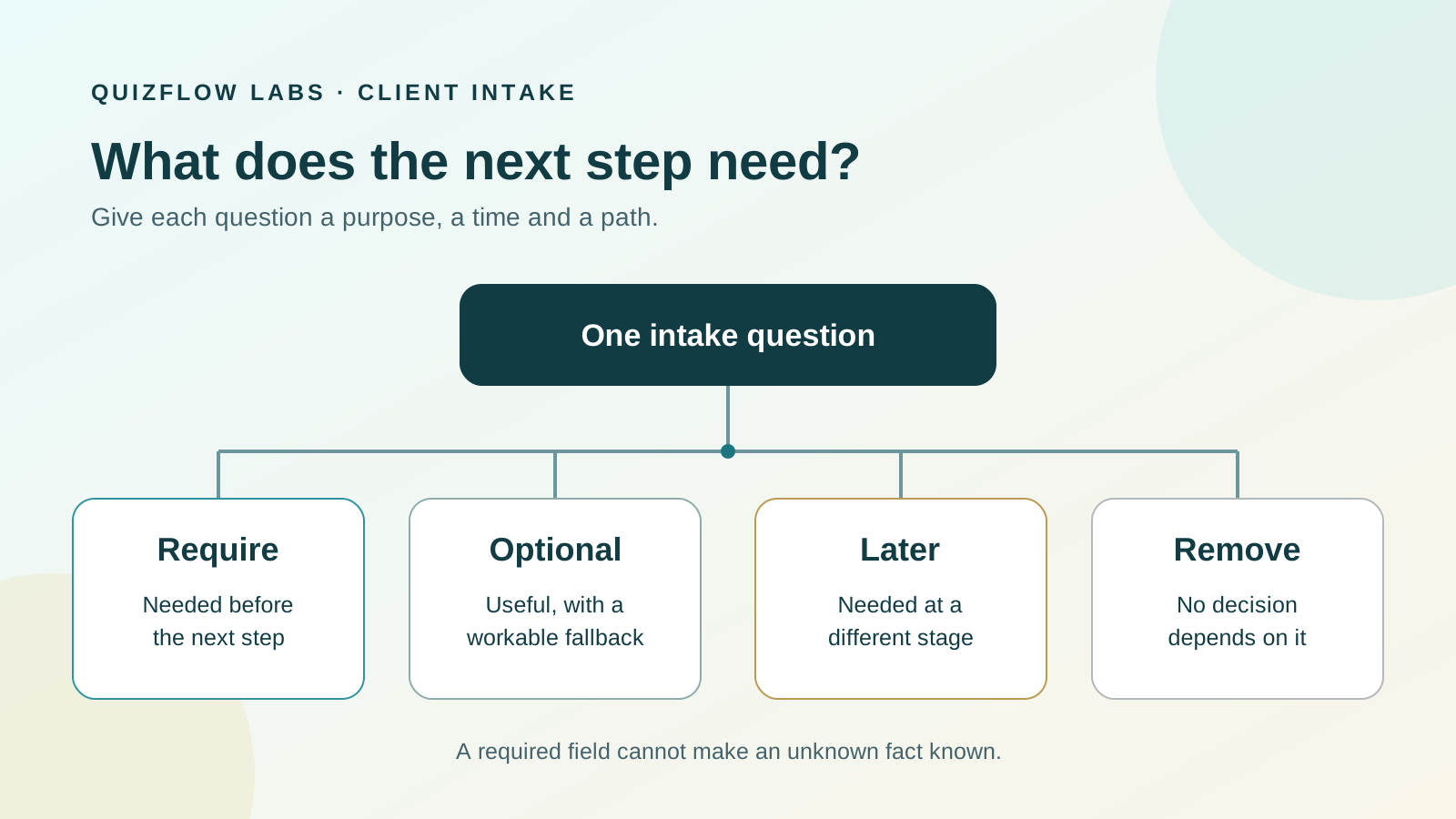
A required answer should protect a specific next step
Required intake questions decide who can continue. That makes them a business decision as well as a form setting: every mandatory answer should protect something the business has promised to do next.
An email address may be necessary to send a requested reply. A detailed project brief may be necessary to price a fixed scope, yet unnecessary to arrange an initial conversation. The same information can be essential at one stage and premature at another.
Use this test: if the answer is missing, what exactly becomes impossible or misleading about the next step? Name the consequence. If the team can proceed responsibly without it, consider an optional question, a later request or removal. If the consequence is real, also check whether the person can reasonably provide the answer now.
Separate useful information from information needed now
For each question, write a short note with four parts: the action the answer changes, who needs it, when they need it and what they will do if it is absent. This makes the requirement open to challenge. “Helpful for sales” is too broad; “the estimator needs the number of recorded episodes before quoting editing work” explains a dependency.
GOV.UK’s guidance on structuring forms recommends a question protocol that records why information is needed and how it will be used. For a business intake flow, extend that idea by naming the latest point at which the answer is needed. A question does not earn a place at the entrance merely because someone will eventually use its answer.
Ask the person who handles the response to walk through a recent type of request using only the proposed required answers. Identify the first decision they cannot make. That is more informative than asking which fields they would like on a form.
Read GOV.UK’s guidance on structuring formsChoose among four treatments
Required and optional are only two of the choices. Timing and relevance can solve problems that a required switch cannot.
Require before the next step
Use this when the answer is necessary to deliver that step, the question applies to this person and they can provide a meaningful answer. Explain the dependency in ordinary language.
Offer as optional
Use this when an answer improves preparation but there is a workable path without it. Decide that path in advance: a general discussion, an unpriced review or a later clarification, for example.
Ask later or only on the relevant path
Use this when the answer matters after a service choice, agreement or initial discussion. Deferring saves the person from researching details before they know whether the service fits; it also creates a later collection task that someone must own.
Remove
Use this when nobody can name an action that changes. Making a purposeless question optional still asks for attention and may collect information the business does not need.
An optional question still has to earn its place. A concise explanation of a useful detail may help someone prepare for a call. A broad “Anything else?” field that nobody reads has no such benefit.
When an essential answer is unavailable, change the promise
A mandatory field cannot make an unknown fact known. If someone needs advice to estimate a project budget, forcing an exact figure can produce a guess rather than a usable constraint. Requiring a longer explanation does not solve that knowledge gap.
Distinguish three situations. A skipped answer has no stated meaning. “I do not know yet” tells you the person lacks the answer now. “This does not apply” tells you the question may be irrelevant. Use explicit choices when those distinctions change the response, and decide what each choice should lead to.
If an essential detail is unknown, offer a next step that can tolerate uncertainty. A scope discussion can proceed without an exact episode count; a fixed-price quote for a defined batch cannot. State that the discussion will establish scope before pricing. If no useful next step exists without the fact, explain what the person needs to find and why, instead of encouraging an invented answer.
Required means an answer must be supplied. It does not establish that the answer is true, complete or sufficient to make every later decision.
An example: intake for a podcast editing service
Consider a hypothetical podcast editor whose intake promises a personal reply about the right service. It does not promise an instant quote. The editor offers ongoing editing and a separate launch consultation.
Service interest is required, with “Help me choose” as a meaningful option, because it determines what the reply should address. Contact details belong in the request because the promised next step is a reply. A website address is optional: it helps the editor prepare, but a creator without a website can still receive useful guidance.
For ongoing editing, the number and typical length of episodes matter before a firm quote. At this first stage, the editor asks for an estimate and allows “Not decided yet.” That answer leads to a scope discussion. For a launch consultation, detailed editing specifications wait until editing is actually being considered.
A full brand history is removed from initial intake because it changes neither the service conversation nor the ability to reply. A draft recording is requested later if the editor needs it to assess the work. The tradeoff is deliberate: the first reply may need a clarification, while the first interaction does not demand a production brief from everyone.
If the offer changes to “Receive a fixed quote for your recorded batch,” the requirement changes too. The editor would need defined batch details and a way to inspect representative material before making that commitment. Copy, questions and follow-up must describe the same service.
Make optional mean that continuing is possible
Label optional questions clearly and explain a benefit when it is not obvious. “Website (optional)” with “Helps us understand the show before replying” gives the field a purpose without implying that a website is a prerequisite. Keep essential instructions visible rather than placing them only in placeholder text that disappears during entry.
Check the whole journey with the answer blank. A form can allow a skip while a later step still assumes a value: an email template may have an empty sentence, a booking handoff may require the same detail, or a team member may refuse to act until it is supplied. In those cases, the question is technically optional but the service has an unresolved dependency.
Treat an omitted answer as missing information. Do not silently interpret a blank deadline as “no deadline” or a blank budget as “lowest budget.” Those are substantive claims the person did not make. Agree on the fallback with the person who handles the request.
See W3C’s guidance on form instructionsSet up the questions in QuizFlow Labs
In a QuizFlow Labs decision flow, Multiple Choice suits a defined service choice, including an explicit uncertainty option when it has a useful meaning. Text Response suits context someone needs to explain in their own words. Both offer a Required response setting; use it according to the next-step dependency you have established.
A required Text Response blocks progress when no answer is entered. It cannot judge whether a typed explanation contains enough information to scope a project. Write a focused prompt and review the answer for that purpose rather than treating the setting as a quality check.
For a multiple-select Multiple Choice question, also check the minimum selection setting. A positive minimum can prevent an empty response even when Required response is off. If skipping should be allowed, check both controls and test an empty response in preview. Changing the word “optional” in the prompt alone does not change validation.
Keep contact collection and its purpose clear, including the difference between a requested service reply and optional marketing. Do not turn a project-context answer into an assumption about communication permission.
Test the missing-answer path before measuring performance
Run three cases for each important question: a usable answer, a blank answer where skipping is allowed, and a truthful uncertainty answer where one is offered. Follow each case through the next step, including the information the recipient needs to act. Confirm that no message promises a quote, recommendation or appointment that the supplied information cannot support.
Then observe someone representative of the intended audience. Ask what they believe is required, what they think will happen if they leave a field blank and how they would find an answer they do not know. Watch for invented details, repeated rereading or a pause to search for records. Those observations suggest different fixes: a clearer label, an uncertainty choice, a narrower question or a later request.
A successful test establishes that the intended paths work for the cases tested. It does not establish that every future respondent will understand the question or provide accurate information.
Judge a requirement by completion and useful follow-up
Completion alone cannot tell you whether a question should be mandatory. Making a field optional may make entry easier while shifting work into follow-up. Requiring it may produce fuller records while excluding people who could have become suitable clients. Judge both sides of the exchange.
For a focused revision, record how many of the people who reach the relevant question finish, then review the resulting requests for a concrete operational problem: could the team take the promised next step without chasing the newly optional detail? Keep the review definition stable. Record requests waiting on clarification separately from requests that were unsuitable for the service.
If blanks increase but the team can still respond usefully, the answer may not need to be mandatory at that stage. If clarification increases, inspect the cases: a vague prompt may need rewriting, while a detail genuinely needed before action may need to become required or move to a different stage. If many entries say “unknown,” investigate whether the offer asks for a decision people need help making.
Compare like requests and note changes in traffic source, service offer or audience. A before-and-after difference is a reason to investigate; it does not isolate the effect of the field setting when other things changed. For a small service business, a careful case review can still reveal a practical failure without pretending to establish a universal conversion rule.
Start with one disputed question
Choose a question the team disagrees about. Name the next-step dependency, decide what happens without the answer and check whether a person can reasonably know it now. Then choose required, optional, later or remove, and test the resulting journey.
The aim is an intake flow that asks for enough information to keep its promise. Every required answer should have a reason; every allowed omission should have a workable next step.
Turn answers into action
Build intake around the next step you can deliver
Create a QuizFlow Labs decision flow with focused questions and a clear path from the first answer to useful follow-up.
Create your intake flow