

Rules or AI: How to Guide Visitors to the Right Offer
A practical framework for choosing branching rules, AI conversation or a hybrid—based on decision clarity, business constraints and the cost of a wrong recommendation.
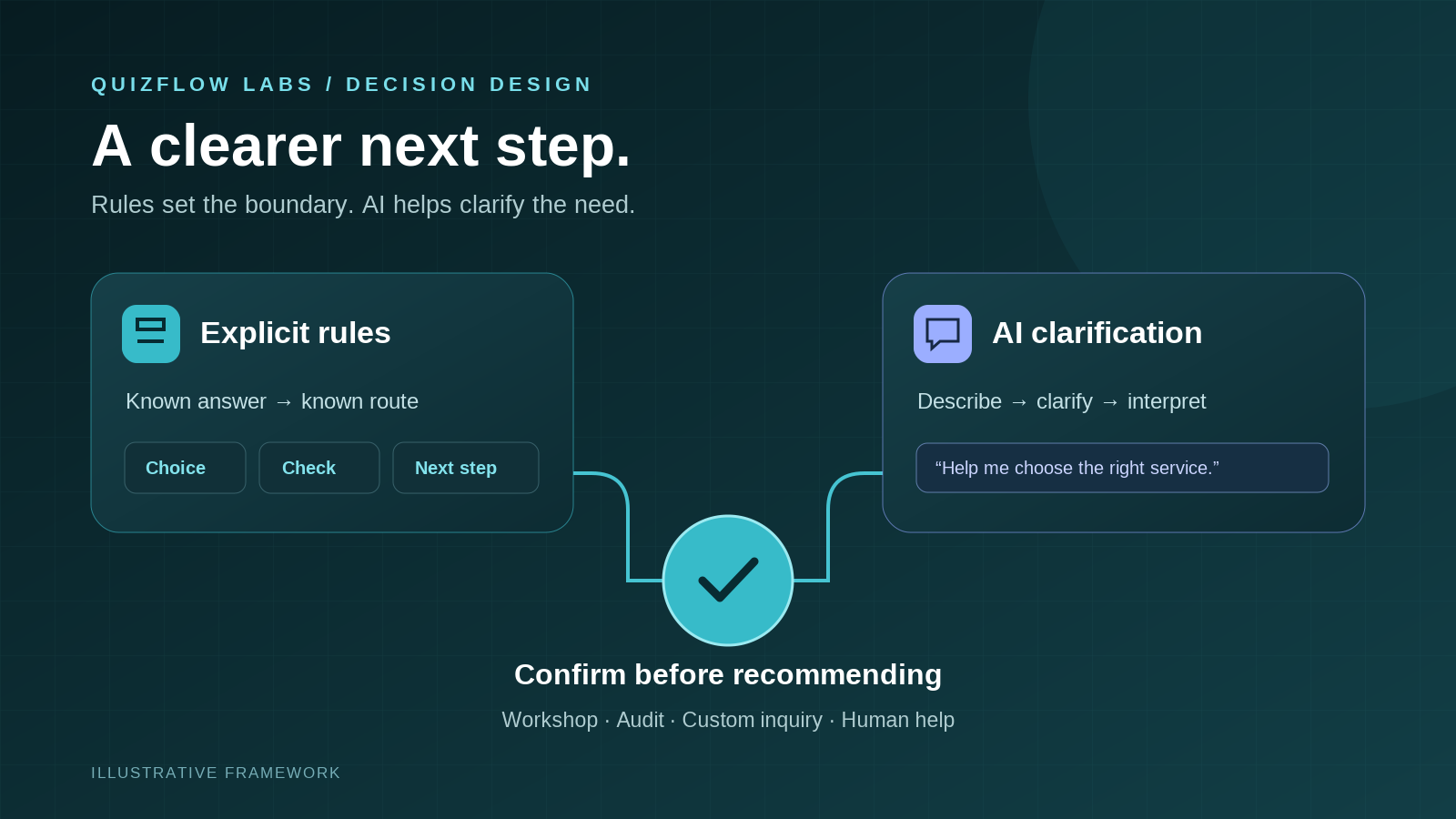
What rules and AI each contribute to a decision funnel
A decision funnel gathers information that helps a visitor reach a relevant next action: a recommendation, a booking, a resource or an inquiry. Its design depends on two separate jobs: understanding the visitor’s need and deciding which next steps the business can responsibly offer.
Branching rules connect explicit answers to defined destinations. AI conversation can interpret a description, ask for clarification and collect information that was difficult to express through fixed choices. Both can help guide a visitor, but they require different kinds of testing.
Choose the mechanism by examining the decision itself. How clearly can the visitor answer? How precisely can the business define the outcome? What happens if the recommendation is wrong? Those questions are more useful than deciding that every funnel needs AI.
Start by defining the decision, not the questions
List the possible outcomes and the facts that distinguish them. A service recommendation may depend on whether the visitor wants training, advice or implementation. Qualification may depend on service area, project scope or a prerequisite. Each fact should have a visible effect on the next step.
Separate firm requirements from preferences. A service-area boundary may rule out an offer; a preference for a shorter engagement may only help rank suitable options. Combining both into a single score can hide why an offer was selected or excluded.
Define what happens when the information is missing, contradictory or outside the offer catalogue. “Ask another question,” “show a comparison” and “invite a human inquiry” are legitimate outcomes. Forcing every visitor into a paid recommendation creates false certainty.
When explicit rules are the better fit
Rules suit decisions with recognizable choices and conditions that can be written down. If a visitor knows which service they need, a direct choice avoids unnecessary questioning. If one answer determines whether a later question is relevant, branching can remove that unnecessary step.
The strength of rules is inspectability. For a given set of answers, the designer can identify which condition should match and where the visitor should go. That makes it easier to review business requirements and trace a wrong recommendation.
Predictable execution does not guarantee a good decision. An unclear question can produce an unreliable input, and an overly broad condition can send several different needs to the same offer. Review both the wording and the rule. In QuizFlow Labs, branching rules are evaluated in order, with the first match winning; overlapping conditions therefore need deliberate priority.
When conversation adds useful information
Conversation is useful when visitors can describe a problem but struggle to select the correct category. An inquiry such as “Our leads look interested but sales keeps rejecting them” might involve qualification criteria, unclear offer expectations or an ineffective handoff. A focused follow-up can reveal which problem needs attention.
The conversation should gather information needed for a decision, rather than improvise a sales pitch. Define the task, the relevant offers, the information to collect and when to stop asking questions. If earlier answers already supply a fact, avoid asking for it again.
Use controlled categories for information that drives routing. A long free-text summary may be useful to a person reviewing an inquiry, but it is harder to use reliably as a branch condition. Categories such as training, audit, implementation and unclear make downstream behavior easier to inspect. The category still needs to reflect the visitor’s actual intent.
Design a hybrid around confirmation and business constraints
A hybrid flow uses conversation to clarify the need and explicit conditions to apply the business’s requirements. It should also let the visitor correct a mistaken interpretation before taking a consequential next step.
Consider this illustrative service-selection flow: a visitor describes a lead-quality problem; a follow-up distinguishes advice from implementation; the visitor confirms “I want a review of our current qualification process”; the flow presents the audit offer and explains its scope. If the request falls outside that scope, it offers a contact path rather than inventing a suitable package.
Confirmation is most useful when it exposes the meaningful interpretation. “You want advice on your current process, rather than a new implementation—is that right?” gives the visitor something specific to correct. A generic “Continue” button does not establish that the interpretation was understood.
Keep claims about prices, eligibility, availability and deliverables tied to authoritative business information. AI-generated wording can be inaccurate even when the selected destination is correct. Evaluate the explanation as well as the route.
Test rules and conversation differently
Rule tests should state the inputs and expected destination before execution. Cover each meaningful condition, overlapping matches, missing inputs and revised answers. A rule change should be checked against previously correct cases as well as the case it was meant to fix.
Conversation tests should check whether the same underlying need is interpreted correctly across different wording. Include incomplete descriptions, several goals in one message and requests outside the catalogue. Look for invented facts, unjustified promises and follow-ups that fail to resolve ambiguity.
Routing correctness
Does the final destination match the explicit answers and confirmed need? A valid URL can still be the wrong offer.
Explanation accuracy
Does the recommendation describe the real offer without adding unsupported scope, pricing or availability?
Correction behavior
If the visitor changes an answer or corrects the interpretation, do the explanation and destination both update?
Uncertainty and interruption
Can an unclear or unsupported request reach a useful alternative? Check service failure separately from an unmatched routing condition.
Keep expected and observed results together. Passing a small set of conversations is evidence about those cases, not proof that every future request will be handled correctly. Recheck representative cases when instructions, offers or attached knowledge change.
Apply the framework in QuizFlow Labs
QuizFlow Labs provides branching logic for explicit conditions and Agent Steps for conversational collection. Map the outcome conditions first, then add an Agent Step where fixed choices leave a meaningful gap in understanding. Keep the Agent’s instructions and source material focused on that gap.
Agent outputs can populate structured variables, and exit conditions determine the next step. Review their ordering and the default for completed interactions that match no exit. A failed Agent request is a separate situation: the documentation describes an availability message at the Agent step, not automatic routing to a contact page.
Agent availability depends on account access, and tests and live calls use separate AI Credits. Check those before relying on conversation as the only entry path. The setup guide covers configuration; the design decision remains whether conversation adds information that a simpler question cannot obtain.
Configure an Agent StepA decision rule for choosing the approach
Begin with explicit choices when the answers and outcome conditions are clear. Add conversation when visitors need help expressing the facts that determine the outcome. Use a hybrid when interpretation is useful but business constraints and visitor confirmation must still govern the next step.
A successful design produces a recommendation that can be explained from the information collected. More questions or more conversation are justified only when they make that decision clearer.
Design the decision
Connect clear answers to relevant outcomes
Review branching behavior and map the conditions behind each recommendation before building the flow.
Read the logic and branching guide