

Should You Offer an Incentive for a Customer Survey?
A reward changes the invitation as well as the budget. Decide what it should accomplish, who it should reach and how you will interpret the answers.
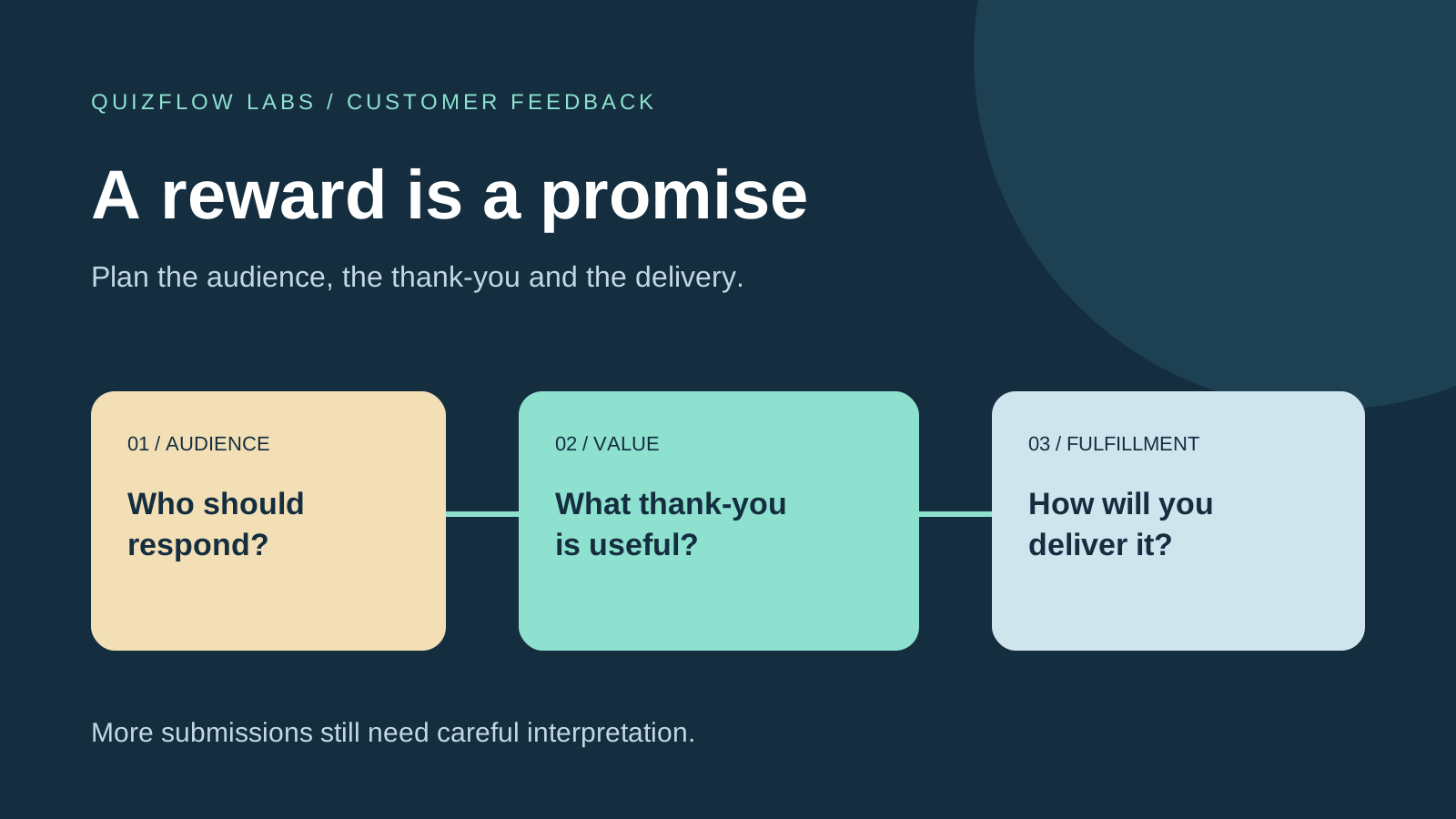
Decide what the reward is meant to change
A customer survey incentive is a reason to participate, not a reason to trust every answer. A small thank-you may make the request feel more worthwhile, but it also introduces costs, fulfillment work and another influence on who chooses to respond. The right decision depends on the information needed and the people whose experience matters.
Start with a specific purpose: learn why recent customers stopped using a course, understand a difficult onboarding step or choose which support problem to investigate. Then identify who has the relevant experience. An incentive cannot repair an invitation sent to people who cannot answer the question.
Use a reward when there is a credible participation barrier it can address and you can deliver the promise fairly. Use no reward when a concise, well-timed request already gives people a useful reason to contribute, or when you cannot support the administration. Neither choice removes the need to examine who answered and who is missing.
Fix the request before paying for more responses
Check the invitation and survey first. Explain why the feedback matters, what experience the questions concern and how long participation actually takes in a test. Remove questions that do not support the decision. A confusing request with a reward is still a confusing request.
Separate lack of motivation from lack of opportunity. Someone who has not used a feature cannot evaluate it more accurately because a voucher is available. Someone who cannot comfortably use the survey on a phone needs a usable experience. Someone who doubts that criticism is welcome needs a credible explanation of how feedback will be handled.
Tufts’ survey guidance treats incentives as optional and identifies both participation benefits and risks such as attracting people outside the intended audience. Its setting is university research, rather than creator businesses; the useful planning principle is to consider audience fit and costs alongside participation.
Before adding a reward, ask a few eligible people to explain the invitation and try the survey. If they cannot tell whether it applies to them or how the thank-you works, correct that problem first. More submissions would otherwise multiply the same ambiguity.
Read Tufts’ survey planning and incentive guidanceOpens in a new tabChoose a thank-you that does not depend on liking the offer
Compare the reward with the audience, not just its face value. A discount on a future purchase is useful only to someone willing and able to buy again. If the survey asks why customers stopped purchasing, that discount may be least relevant to the people whose experience is most important. A resource for beginners can similarly be unhelpful to experienced customers.
A broadly usable gift can reduce that particular mismatch, but delivery and redemption still matter. Check whether recipients can use it in their location, whether it expires and whether claiming it requires extra effort or an unwanted account. A nominally generous reward can be inconvenient in practice.
Also decide when the reward is given. A prepaid thank-you is delivered before participation and costs money even when someone does not answer. A promised thank-you is delivered after the stated participation conditions are met; it creates a fulfillment obligation and may require contact details. FORS’ survey-methods guide discusses these designs and recommends considering delivery, budget and the intended population. It does not establish a universal reward amount for a customer survey.
Keep the reward independent of the sentiment expressed. Negative feedback, an undecided answer or an honest lack of experience should not reduce someone’s entitlement under the stated offer. Avoid wording that makes the reward sound like payment for praise.
Read FORS’ guide to incentives in surveysOpens in a new tabBudget for the promise, not just the expected turnout
For a guaranteed reward after participation, calculate the largest obligation your invitation can create: eligible participants multiplied by reward value, plus delivery fees and administration. Forecast likely spending separately. An optimistic completion forecast is not a safe ceiling for a promise to every eligible respondent who meets the stated conditions.
An open public link makes that ceiling harder to establish. If the budget only supports a limited invitation, use a recruitment and fulfillment process that can actually maintain that limit. Do not promise a reward to everyone and introduce an undisclosed cap after responses arrive.
Write down who handles fulfillment, what information they need, when rewards will arrive and how a missing reward will be resolved. Test that process before inviting customers. A completion message saying “thank you” is not evidence that a promised gift has been delivered.
Example: feedback from customers who left a course
Hypothetical example: a creator wants to understand why customers stopped using a self-paced course. The invitation list contains 120 eligible former customers. The creator considers a $5 thank-you after participation, delivered manually by email within seven days. If every invited person qualifies and participates, rewards alone would cost $600; fees and staff time are additional.
A discount on the next course would cost less upfront, but it would be a poor match for learning from customers who no longer want another course. The creator chooses a gift usable without another purchase and confirms that the fulfillment process can handle all 120 invitations.
The invitation states who the survey is for, the tested time estimate, the reward, the participation conditions and delivery timing. It says that critical feedback is welcome. The creator does not advertise a public reward link, and plans how to handle forwarded invitations without changing the promised terms.
For interpretation, the creator records the invitation group and incentive alongside the findings. Even if participation is higher than in an earlier survey, that alone cannot show that the feedback represents all former customers more accurately. The topic, timing and people invited may also differ.
Collect reward details deliberately
Reward fulfillment can require identifying information that the feedback itself does not need. Decide whether the business needs to connect a reward claim to an individual survey response. Verification makes administration easier in some designs, but that connection affects what you can truthfully tell people about privacy.
If contact details are collected separately, inspect whether identifiers, personalized links or other records still connect the two datasets. A separate form alone does not establish anonymity. Describe what you actually collect and link, restrict access to fulfillment information and decide how long it is needed.
Keep a request to receive the thank-you separate from a request to receive marketing. Someone supplying an email for delivery has expressed a different purpose from someone asking for promotional messages. Explain both purposes plainly rather than making the reward request do double duty.
Only collect what the chosen delivery method needs. Do not add detailed personal questions merely because there is now a reward budget. Extra information creates work and responsibility without necessarily improving the decision.
Review participation, answer quality and fulfillment separately
Keep three questions distinct: did eligible people participate, did their answers help the decision and did the promised rewards arrive? A rise in submissions with a growing delivery backlog is an operational problem. A rise in submissions with little relevant experience may be a recruitment problem. Neither is resolved by simply increasing the reward.
Before collecting responses, define what makes a response usable for each analysis. Someone who stopped before reaching a feature may be unable to rate that feature while still offering valuable evidence about why they left. Do not discard the entire response because one question does not apply.
Review suspicious patterns using more than one clue. Short completion time can reflect a short survey or a quick reader. Repeated choices can be genuine. Contradictory answers, irrelevant text or repeated claims deserve investigation, but an inconvenient opinion is not a quality failure. Keep analysis exclusions documented and separate from reward decisions under the published terms.
If enough eligible invitations are available, a planned comparison can help evaluate an incentive. Randomly allocate invitations to otherwise equivalent reward and no-reward groups, keep the survey and timing the same and compare participation and usable answers per invitation as well as cost. With a small customer list, treat the result as exploratory; a few extra responses do not establish a reliable effect.
Do not infer an incentive effect from a before-and-after comparison that also changes the audience, survey or invitation. Record those differences and investigate who is still missing. For public reporting, AAPOR’s disclosure standards call for describing incentives and their delivery along with recruitment and data-quality procedures. That context helps readers assess what the findings can support.
Read AAPOR’s survey disclosure standardsOpens in a new tabMake the completion step match the promise
In QuizFlow Labs, Outcomes lets you write the completion title and message and add an Open a link action. Use the message to restate the next step and expected timing. If a separate reward-claim page is part of the process you manage, give its link a clear label such as “Request your survey thank-you.” Keep reward delivery in the fulfillment process rather than implying that clicking the link proves payment.
Test the handoff from the participant’s perspective: can they find the next step, understand what information is needed and tell when to expect delivery? Also test the process for someone who chooses not to claim the reward. Their feedback should still reach the analysis if it meets the survey’s stated criteria.
Choose the simplest incentive arrangement that serves the research question and can be honored. Improve the request, choose a suitable thank-you, fund the full promise and review the answers in context. A successful incentive supports useful participation without making a larger response count stand in for better evidence.
Configure the outcome message and next actionTurn answers into action
Build a feedback flow with a clear next step
Use QuizFlow Labs to ask focused questions and give participants a useful completion message and next action.
Start building your feedback flow