

How to Test a Branching Quiz After an Answer Changes
A branching quiz needs to handle corrections as well as first choices. Compare revised and fresh journeys to find irrelevant answers, missed questions and results that still reflect an abandoned path.
A correction changes more than one answer
Branching quizzes guide people by using an answer to decide which question, recommendation or next action comes next. Changing an early answer can therefore change the meaning of everything that follows. A flow that works on a straight trip through each branch still needs to work when someone corrects a choice.
The risk is an inconsistent decision: the visitor selects a service but receives a workshop recommendation, skips a newly relevant question, or sees an explanation based on a path they abandoned. Reopening the right question is only the beginning of recovery.
Test the journey after the correction. Check what information is now relevant, what must be asked next and whether the final action follows from the visitor's current answers. This is especially useful when branches rejoin, answers affect scores or several offers share a completion screen.
Define what should change and what should stay
Start with the business decision, before inspecting the configured rules. For each answer that changes the route, write what its dependent questions establish. A question about editing experience may select a learning workshop; a question about episode length may help scope an editing service. Those answers do different jobs.
When the route changes, sort the earlier information into three groups. Still-relevant answers can remain useful. Answers whose meaning depended on the old route should stop influencing the new decision. Newly relevant questions need an answer before the flow makes a promise that depends on them.
This does not mean erasing everything after a correction. Requiring someone to retype a project description that still applies creates unnecessary work. Conversely, retaining a value does not establish that it is valid for every route. A hidden question, a remembered answer and an answer used in a recommendation are three different things.
The Scottish Government's check-answers guidance recommends retaining entered information and following the form logic to further questions when an answer changes. For a recommendation flow, apply that principle by checking both continuity and relevance: preserve useful work without letting an abandoned choice decide the outcome.
Read the Scottish Government guidance on changing answersOpens in a new tabCompare a revised journey with a fresh journey
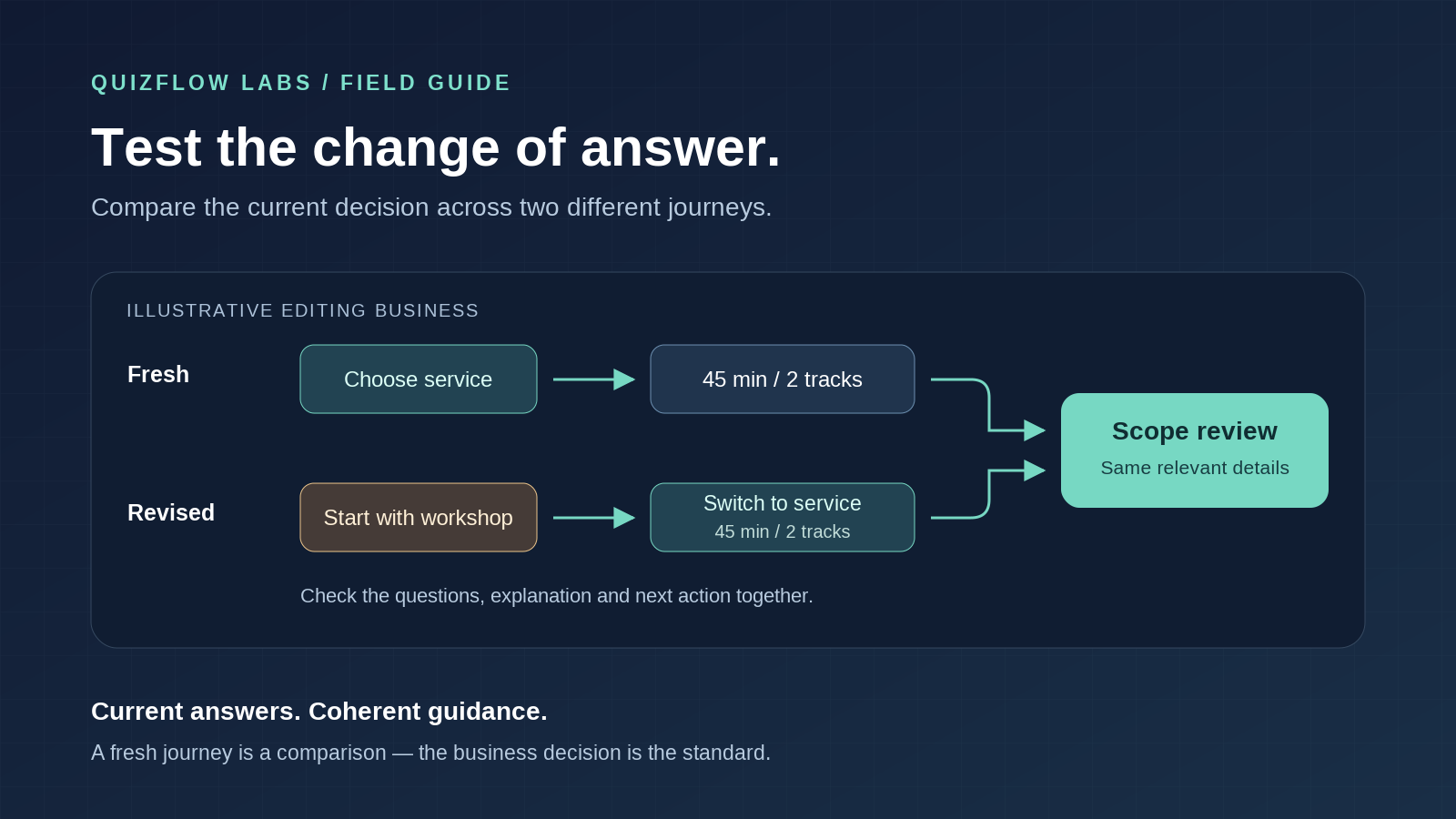
A useful comparison starts with two journeys that end with the same relevant information. In the fresh journey, choose the intended route immediately and complete its questions. In the revised journey, enter a different branch, answer its questions, use the flow's correction controls to change the earlier choice, then supply the same relevant answers as the fresh journey. Start a new run with no carried answers for the fresh case; returning to the first screen does not by itself establish a reset. Use invented test details so each case can be repeated without real customer information.
Write the expected questions, result and next action before running either case. A fresh journey can be wrong too; matching it is a consistency check, not proof that the recommendation is good. Both journeys must also satisfy the business decision you wrote down.
If the decision is meant to depend only on current answers, the two journeys should produce equivalent guidance. Equivalent does not require identical wording, but the offer, eligibility explanation and commitment should agree. If history intentionally matters, name that rule and test its expected difference separately. Do not use an unexplained difference as evidence of personalization.
Software testing distinguishes reaching a state from testing the transitions into it. ISTQB's Foundation Level syllabus describes state-transition tests as sequences of events and changes. For a creator's quiz, the practical lesson is to test how a person reaches a recommendation, including corrections, as well as whether each recommendation can appear.
See ISTQB's state-transition testing guidance, section 4.2.4Opens in a new tabExample: a podcast business with two routes
Consider a hypothetical podcast business offering editing workshops and a managed editing service. The first question asks whether the visitor wants to learn editing or have episodes edited. The learning route asks about experience to choose an introductory or advanced workshop. The service route asks about recording length and track count to prepare a scope review. Both routes then ask a shared question about the project goal before completion, leaving a point at which the visitor can go back after answering the branch-specific questions.
The intended decision is explicit: workshop experience selects a workshop only on the learning route. Service details prepare a scope review only on the managed-service route. The scope review is not a confirmed price or booking.
Use these cases to check the decision and the correction:
Fresh service journey
Choose ‘Have episodes edited,’ supply 45 minutes and two tracks, then continue. Expect a scope-review next step that reflects those details and makes no workshop recommendation.
Learning to service
Choose ‘Learn editing,’ answer ‘Experienced,’ then go back before completion and switch to ‘Have episodes edited.’ Supply the same 45 minutes and two tracks. Expect the same service decision as the fresh journey; the abandoned experience answer must not select an advanced workshop.
Service to learning
Enter the service details first, then change to ‘Learn editing.’ Answer ‘New to editing.’ Compare with a fresh beginner learning journey. Expect the introductory workshop; the previous recording length must not turn it into a service inquiry.
Return to the original route
Move from learning to service and back to learning before completion. Check the experience answer shown on return. Keep or change it deliberately, then verify the workshop matches that current answer. If re-entry requires an answer again, it must be clear rather than silently assumed.
Keep the shared project-goal answer the same within each comparison pair, so it cannot explain a different result. Record the answers actually visible after each change. Do not assume the flow retained or cleared them. If a shared question remains relevant, check that its wording still fits both routes. ‘How soon do you need the finished edit?’ would not make sense for someone choosing a workshop.
Choose changes that exercise real dependencies
Testing every sequence of clicks can become unmanageable. Prioritize changes that replace an offer, introduce a required question, remove a scored input or alter a consequential next action. These changes can expose more than a harmless difference in page order.
For each important split, test both directions after answering at least one branch-specific question. Changing the first choice before entering any details will not reveal whether those details improperly survive into a later decision. Where branches rejoin, continue through the shared section and inspect the outcome.
Also change an answer without switching branches. A beginner-to-experienced correction should update a workshop recommendation even though the route remains ‘Learn editing.’ This separates a problem updating an answer from a problem switching between routes.
Keep the first tests short and reproducible. Change one consequential answer at a time, record the first unexpected step, and add a longer back-and-forth sequence after the simple cases pass. A complex sequence may reveal a problem while making its trigger harder to identify.
Diagnose the first point where the journeys diverge
A wrong result does not identify the cause. Trace the revised journey from the correction onward and find the earliest mismatch with the expected behavior. Use that location to choose the next investigation.
The changed choice is not reflected on return
Check whether the correction was accepted and whether continuing was required. A visibly selected option and a completed navigation step may be separate actions. Reproduce the exact interaction before changing a routing rule.
The new branch never appears
Inspect the condition, destination and any earlier matching rule. If the fresh journey also takes the wrong route, investigate the decision configuration before assuming the fault depends on navigation history.
The route is right but a necessary question is missing
Inspect the branch entry and the point where paths rejoin. The route may enter too late, or a remembered value may be treated as sufficient without confirming that it still answers the current question.
Questions are right but the result or explanation is wrong
Inspect outcome conditions, scores, answer references and the final action separately. A correct result title can conceal an explanation or button that still belongs to the old offer.
A mismatch is evidence to investigate, not proof of a particular software defect. Save the initial route, earlier answers, correction, later answers and first wrong screen. That record is more useful for a fix than a screenshot of the final result alone.
Check the result as a bundle of promises
Review the recommendation, explanation, displayed answers, score if used, button label and destination together. They should describe the same current decision. ‘Introductory workshop’ above a ‘Request editing quote’ button is still an inconsistent outcome.
Treat any obsolete answer in a displayed summary as a separate finding, even when the destination is correct. It may confuse the visitor about what will happen next. If a score changes after a correction, reconcile it against the current decision's intended inputs; a plausible total alone does not show which answers contributed.
Keep pre-completion corrections separate from changing a submitted response. A new recommendation does not by itself cancel a booking, retract an email or undo an earlier submission. Test those actions in an appropriate test environment if the flow triggers them. For the initial routing check, stop before sending messages, paying or creating real appointments.
Run the cases in QuizFlow Labs
In QuizFlow Labs, inspect the relevant question's Jump Logic and write down its conditions and destinations. Rules are evaluated from top to bottom and the first match wins. When no Jump Logic rule matches, the flow normally continues to the next sequential question; other configured routing, such as an intent's end route, can also apply. Include the no-match case in the test record rather than assuming it produces a particular offer.
Use preview to run the fresh and revised cases with the correction controls available in that experience. Keep a record of the steps reached and the outcome content, not just the arrows in the builder. A routing diagram cannot show whether a visitor's correction produces a coherent explanation and action.
After configuring the flow, repeat the relevant cases on the publishing surface people will use. Distinguish an in-flow Back control from the browser's Back button; they are different interactions and should be checked separately if the journey relies on them. A successful preview is useful evidence, but it does not verify every host page or downstream destination.
Read the QuizFlow Labs Jump Logic and Branching guideKeep the cases when the flow changes
Retain the paired journeys as a small set of repeatable checks. Rerun affected pairs when an offer, condition, question or destination changes, and include the route on each side of a shared section. GOV.UK Forms likewise warns that moving questions, changing answer types or deleting routed options can require route updates.
Hold a path that makes a misleading recommendation, omits information needed for its next action or prevents a visitor from correcting a consequential answer. Repair the first mismatch, rerun that case, then check its reverse and fresh comparison. Passing one corrected journey does not establish that the neighboring paths remain sound.
Start with one branch that changes a real business decision. Define its current-answer requirements, compare a fresh and revised journey, and explain any difference. The goal is a flow that helps people recover from a change of mind with a next step they can still trust.
Read GOV.UK Forms guidance on route changesOpens in a new tabBuild a dependable decision flow
Connect each current answer to a useful next step
Use the QuizFlow Labs Jump Logic guide to configure your routes, then test the fresh and revised journeys that matter to your recommendation.
Explore Jump Logic