

Should Your Survey Ask for an Overall Rating First?
Question order changes the context in which people answer. Decide whether to capture an initial judgment or a considered summary, then test the sequence without confusing a survey change with a business improvement.
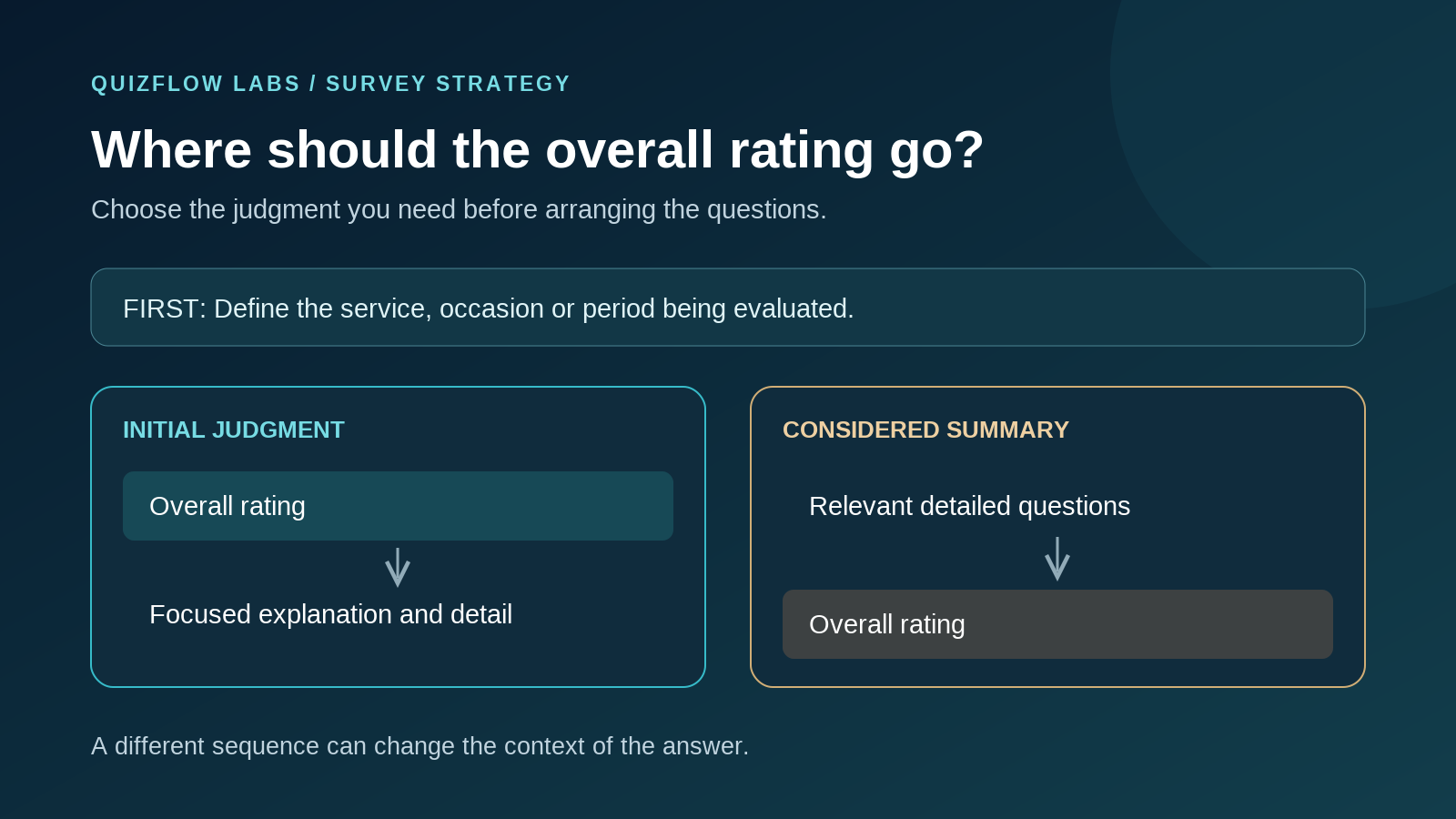
Choose what the overall question should measure
An overall satisfaction question can look identical in two surveys and still arrive in very different contexts. A rating asked before detailed feedback captures a judgment before those prompts. The same rating asked after questions about price, reliability and support invites a judgment with those subjects already in mind.
Neither position is automatically right. A creator tracking the overall experience may want the rating early. A business inviting customers to review several parts of a service may want a considered summary at the end. Decide which judgment will help the business act before arranging the questions.
Write that purpose in one sentence: ‘We want an overall assessment of this month's membership before asking about individual features.’ Or: ‘We want a summary after customers have reviewed the parts of their project.’ Those are different measurement goals, even if both use a five-point satisfaction scale.
Understand the context a question creates
Earlier questions can influence how people interpret later ones. The Australian Bureau of Statistics distinguishes a general-first sequence from a specific-first sequence that deliberately encourages respondents to consider particular topics before giving a broader answer. Its guidance makes the choice depend on why the general question is included.
Apply that distinction to the decision the rating will support. If the question is meant to summarize an experience in the customer's own terms, a long list of your preferred criteria may narrow that frame. If it is meant to summarize a defined review, omitting the review may leave the task underspecified.
There is also a practical tradeoff after an early overall rating: later comments are given by someone who has already expressed a judgment. Treat them as explanations offered in that sequence, rather than assuming they independently prove what caused the score. A useful account of an experience is not automatically a causal analysis.
Read the ABS guidance on question contextOpens in a new tabPut necessary scope before the rating
‘Overall first’ does not mean asking a rating before people know what they are evaluating. State the service, occasion or period. If a survey covers several experiences, establish which one applies before asking someone to judge it.
For example, ‘Thinking about the live class you attended on 14 October, how satisfied or dissatisfied were you with the class overall?’ defines a target. ‘Before you rate the class, consider our expert teaching and excellent resources’ supplies an evaluation. Keep the first kind of context; remove the second.
Use a short factual question where relevance genuinely depends on it. Someone who did not attend the class needs a different question, not a forced opinion about attendance. Check that each possible answer has a sensible continuation before sharing the survey.
The UK Government Analysis Function recommends logical topic grouping, appropriate filtering and attention to the influence of earlier questions. These aims work together: a coherent sequence should help people understand the task without quietly telling them which considerations deserve the most weight.
Read the Government Analysis Function's question-order guidanceOpens in a new tabKeep diagnosis separate from the overall judgment
After choosing the rating's role, decide what each remaining question will help you investigate. A question about finding a resource, a question about its usefulness and a question about contact with support describe different parts of an experience. They should earn their places through the decisions they inform.
For an early-rating survey, one practical sequence is scope, overall judgment, focused explanation, then any essential detail needed to act. An open prompt such as ‘What most influenced your answer?’ asks for the respondent's account before supplying a list of possible reasons. It still follows the rating, so it is not an unprompted account of the entire experience. This wording also works for someone who chose an option saying they could not judge.
For a review-first survey, choose the dimensions because they define the service being reviewed. Avoid building a summary out of three questions about problems and one question about benefits, then treating the result as a neutral verdict on everything the business offers. The scope of the review must match the scope of the summary.
Do not ask the same overall rating both before and after the details merely to see whether it moves. The second answer comes from someone who has seen the first question and the intervening prompts. That is a different task from comparing two sequences shown to different people.
Example: two useful surveys for a membership business
Consider a hypothetical monthly design-template membership. The owner needs to decide whether members are getting value from the membership as a whole or whether a particular part of the service needs repair. These decisions call for related, but different, questions.
For overall monitoring, the introduction names September's membership experience. The first question asks, ‘Overall, how satisfied or dissatisfied were you with the membership during September?’ The choices run from very dissatisfied to very satisfied, with a separate ‘Not enough experience to judge’ option. Next comes, ‘What most influenced your answer?’ A final question can clarify a concrete issue the owner is prepared to investigate.
For a focused resource-library review, the survey first establishes whether the member used the library during September. Relevant respondents then answer about finding a template and whether the templates they used met their needs. A final question asks about satisfaction with the resource library overall. Members who did not use it should not be asked to rate its usability as if they had.
The second survey is useful for deciding what to repair in the library. It does not replace the first survey's measure of the whole membership. Different scope alone prevents treating the scores as the same measure; putting its summary at the end adds another difference.
If the owner wants to test order itself, keep the scope and every question unchanged and compare the overall-first and overall-last versions of that same survey. Comparing the two surveys above would mix question order with a different subject and a different set of respondents.
Test comprehension before trying to measure an order effect
Start with a small pilot whose purpose is to find misunderstandings. Let a participant complete one sequence without coaching. Afterwards, ask what experience they thought the overall question covered and what they considered when choosing an answer. Compare that account with the intended scope.
If someone rates only customer support when the question names the whole membership, inspect the introduction and preceding prompts. If someone needs later information to understand the rating, move the necessary definition earlier or narrow the question. Record the specific misunderstanding and the change intended to address it.
A pilot can reveal a plausible mechanism; it cannot tell you how common or large the effect is among customers. Showing one person both versions also introduces prior exposure. Use fresh participants when checking a revised sequence, rather than treating a rehearsed answer as confirmation.
When a numerical estimate would change a consequential business decision, an order experiment needs a different design. Randomly assign eligible respondents to one version, keep wording, choices, invitations and timing consistent, and compare the same measure. Pew Research Center explains this use of randomized question-order experiments. Plan the analysis and sample requirements before interpreting a difference; a few replies per version are not a dependable estimate. Compare completion and the distribution of ratings separately, and report how many people in each version actually gave a rating. A difference in who finishes can also affect the comparison.
If the audience is too small for a useful comparison, choose the sequence that matches the measurement goal and document it. Collecting a tiny experiment is not a requirement for publishing a carefully tested survey.
Read Pew Research Center's explanation of survey experimentsOpens in a new tabDiagnose a changed score before calling it progress
Keep a dated copy of each survey version, including the introduction, question sequence, choices and paths. When changing order, record why. That gives a later reviewer a way to distinguish a service change from a measurement change.
If a rating changes after moving detailed questions earlier, investigate context alongside changes in the service and the people replying. If explanations concentrate on one newly introduced topic, inspect whether the survey made that topic unusually prominent. That pattern is a reason to investigate, not proof that order caused the change.
If the new version has fewer completed surveys, inspect where the pilot participants struggled and whether early questions ask for difficult recall or irrelevant detail. Completion alone cannot establish that the answers are more meaningful; a shorter version may also have removed information the decision needs.
When no experiment or overlapping comparison can separate the effects, treat the revised survey as a new baseline. Report the version change beside the numbers. An apparent improvement across two different instruments should not become a claim that the business improved by the same amount.
Build the sequence around a useful next action
In QuizFlow Labs, use a Multiple Choice block in single-select mode for a verbal satisfaction scale, and a Text Response block for a written explanation. Keep the rating choices in a consistent progression and provide a separate option when someone cannot judge. Use the explanation to investigate a decision, rather than collecting a comment with no review plan.
Preview the complete sequence on a phone as well as a desktop. Read the introduction and questions in the order participants encounter them, including every continuation affected by an earlier answer. A review of isolated question text will miss context created by the flow.
Before sharing, name the decision the survey will inform, place the overall question accordingly and identify who will review the responses. The sequence is ready when people understand what they are judging and the business knows what it will do with the answers.
Turn answers into action
Build a feedback flow with a clear purpose
Create your survey in QuizFlow Labs, check the full question sequence and connect the feedback to a useful next decision.
Create your feedback flow