

How to Build a Knowledge Check That Tests Understanding
A correct answer is useful only when it tells you something about learning. Design short course and workshop quizzes that reveal reasoning, expose specific mistakes and guide the next practice.
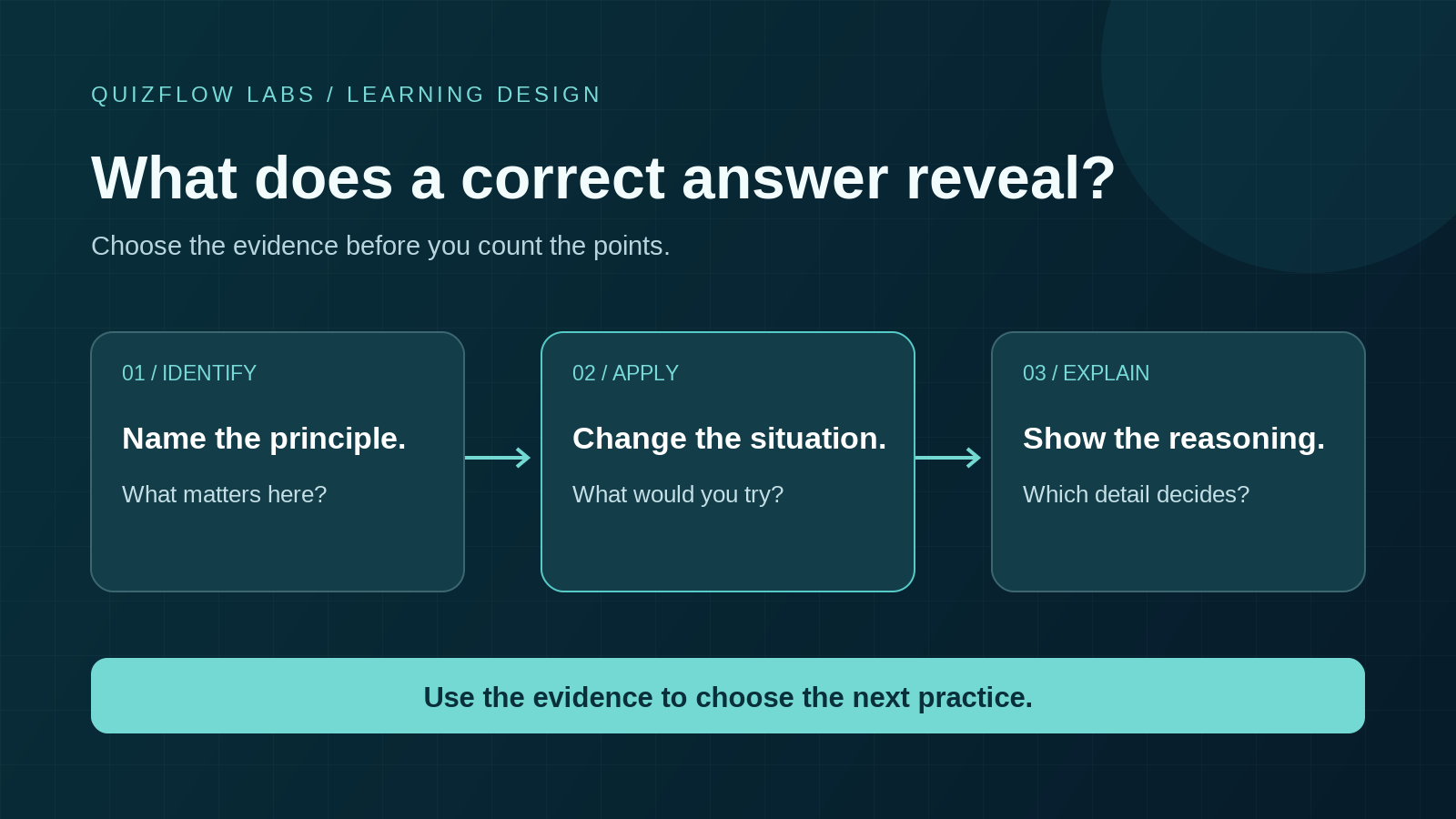
A quiz score should help you choose what to teach next
Knowledge checks give course and workshop creators a way to see what learners can do with an idea. Their value depends on what the questions reveal. Recognizing a phrase from a lesson, choosing an appropriate action and explaining a decision are different achievements, even when each earns one point.
A useful check connects a learning goal to evidence and then to an instructional decision: continue, explain a distinction, provide another example or offer more practice. Without that connection, a score can look reassuring while leaving the creator unsure what a learner needs.
For a short, low-stakes check, start with one important skill and decide what would count as evidence of it. The aim is to make a better teaching decision, not to turn a few quiz answers into a claim of professional competence.
Start with the action, then choose the evidence
Replace a broad goal such as understand recording quality with an observable action: given a recording problem and its constraints, choose a suitable first adjustment. State the conditions too. Choosing a fix while reading a guide is a different task from diagnosing an unfamiliar problem without help.
Carnegie Mellon's Eberly Center recommends aligning learning objectives, instruction and assessment. The practical implication is to teach and practise the action you intend to check. If the lesson only defines terms, an unexplained troubleshooting scenario may test experience learners brought with them rather than what the lesson taught.
Decide what you need to see. A fixed-choice question can show whether someone selects a suitable action from the options provided. A short written explanation can reveal the reason for that choice. If the goal is to produce a clean recording, include an actual recording task at some point: selecting advice is only part of that skill.
Read Carnegie Mellon's assessment alignment guidanceOpens in a new tabUse different questions for recall, application and reasoning
A recall question is appropriate when a fact or term is itself necessary. It becomes insufficient when the learning goal is choosing what to do. For that goal, change a relevant feature of the lesson's example and ask learners to use the principle again. Change enough to require a decision while keeping the task within what was taught.
Then ask which detail made the choice appropriate. A correct selection with an unrelated explanation is weaker evidence than a selection supported by the relevant condition. It gives you a reason to probe further before concluding that the learner understands the distinction.
Carnegie Mellon's exam-design guidance distinguishes recognizing an argument from articulating one. Use a written response or a conversation when explanation is the goal. That costs more review time than fixed-choice scoring, so reserve it for a distinction important enough to affect the next lesson or task.
Read Carnegie Mellon's guidance on choosing assessment questionsOpens in a new tabMake incorrect choices reveal a specific mistake
An incorrect option, often called a distractor, is most useful when it represents a plausible misunderstanding. Before adding it, write down the reasoning that could lead someone to select it. An absurd option may make the question easy without helping you distinguish understanding from elimination.
NC State's multiple-choice guidance recommends realistic situations, plausible distractors and avoiding clues in grammar or wording. Keep the alternatives comparable: do not make the correct choice the only careful sentence among three obviously careless ones. Put the necessary conditions in the question so that one answer is defensible under those conditions.
Treat your interpretation of a wrong answer as a hypothesis. A learner might choose it because of a misconception, an unclear phrase or a missed detail. A follow-up explanation helps you tell those possibilities apart. The option alone does not diagnose the person.
Read NC State's multiple-choice question guidanceOpens in a new tabAn example: checking a recording decision
Consider a hypothetical workshop on recording spoken audio. It teaches that microphone placement affects the balance between direct voice and room sound. Learners have practised moving closer to a microphone and adjusting the recording level to avoid clipping.
The check asks: a voice recording sounds distant and includes too much room sound. The microphone is across the desk, the room cannot be changed and the level is not clipping. Which adjustment should you try first? Ask learners to select one answer.
Move closer and reset the level
Move the microphone closer to the speaker, then adjust the input level as needed. This applies the taught placement principle while accounting for the changed level.
Raise the level from the same position
Increase the input level without changing placement. This treats a balance problem as a loudness problem; it raises the recorded room sound along with the voice.
Raise playback volume
Turn up the listening volume without changing the recording setup. This changes how loudly the existing recording is heard, rather than how it captures the voice and room.
The first option is the intended answer under the stated conditions. Follow it with: which detail in the situation made placement worth changing? Look for a connection between the distant microphone and the balance of direct voice to room sound, rather than a general statement that louder recordings are better.
For another practice, use a recording that is already close but clips on loud words. Now the relevant adjustment changes. Give the explanation of the first case before the new practice if the purpose is teaching; withhold it until both responses are collected if the purpose is to check unaided reasoning across the two cases.
These questions examine a narrow decision. To check whether someone can carry it out, ask them to make and compare recordings. The quiz can identify where to start that practice; it cannot replace listening to the work.
Read Shure's guide to microphone placementOpens in a new tabChoose when to explain the answer
For practice, feedback should tell the learner what distinction to use next. Explain why the intended action fits the conditions and why a tempting alternative does not. Correct or Incorrect confirms a result; it does not supply that reasoning.
If you want an unaided explanation, collect it before revealing the answer. Once a learner has read the rationale, a matching explanation can show that they followed the feedback, but it is no longer evidence of their original reasoning. Both observations are useful when you keep their meanings separate.
For a later check, use another case that requires the same principle rather than simply asking the identical question again. A successful retry of the original item may reflect recognition of its answer. Applying the idea to a changed case gives you additional evidence, though one case still covers only a small part of the skill.
Keep correctness and points aligned in QuizFlow Labs
QuizFlow Labs can support a knowledge check as an interactive decision flow. Use a single-select Multiple Choice block when the task has one best answer. Configure the Answer Key for correctness and configure option scores separately if you want a points total. Marking an answer as correct is not, by itself, the same as assigning it one point.
The Multiple Choice editor's Set standard test scores control sets correct choices to one point and incorrect choices to zero. Check the resulting values before using the total as a count of correct answers. That interpretation depends on every included item using the same one-or-zero scheme. Compare totals only when learners answered the same scored items; questions skipped by routing do not contribute points.
Immediate feedback uses the Answer Key to show right/wrong confirmation. Use it when that brief confirmation serves the practice; place a fuller teaching explanation in content learners can read at their own pace. Use Text Response without an answer key when learners need to explain their reasoning for you to review. A written explanation should not be judged by whether it matches one expected phrase.
Preview each correct and incorrect path, confirm the displayed feedback and verify the points. Leave Immediate feedback off on a choice question if the following question asks for unaided reasoning. Keep explanation questions ahead of answer-revealing content. The intended teaching sequence matters as much as the answer key.
Pilot the check before interpreting its scores
Try the complete check with a few people who resemble the intended learners. Ask what they think each question is asking, how they ruled out options and what detail determined their answer. This is a way to find defects in the questions, not a representative estimate of how an entire audience will perform.
If someone answers correctly because one option sounds more professional, remove that clue and try again. If a knowledgeable learner defends another answer using a condition you left unstated, clarify the condition or accept that the item does not have one best answer. If the interface or reading burden obscures the task, simplify it before blaming the lesson.
Keep a short note for each item: intended skill, expected reasoning, plausible mistake and next teaching action. When you revise the wording, options or scoring, record the revision. Otherwise, a later score change may reflect the question change rather than a difference in learning.
Interpret patterns at the question level
Start with answers to the important items, not only the total. Two learners with the same points may need different help: one may know the terminology but misapply it, while another chooses the right action but cannot yet explain why. Their next practice should address the missing evidence.
If many learners choose the same wrong option, inspect their explanations and the question before reteaching. A shared misconception calls for a contrasting example; an ambiguous condition calls for an item repair. If the answers are correct but an actual task fails, add observation or task practice instead of celebrating the quiz score.
For a small group, keep counts visible. Three of five learners missing a distinction is a useful reason to inspect it, not a stable estimate of difficulty for every future cohort. Separate first attempts from attempts after feedback. Do not treat a higher retry score as an equivalent unaided measurement.
Begin with one consequential skill, one case that requires using it and one way to see the reasoning. Decide what you would teach differently for each plausible result. That gives a short knowledge check a clear job and gives the learner a useful next step.
Turn answers into a useful next practice
Build a knowledge check with a clear learning purpose
Create a QuizFlow Labs flow with focused questions, intentional scoring and a next step that helps learners practise what they need.
Create your knowledge check